
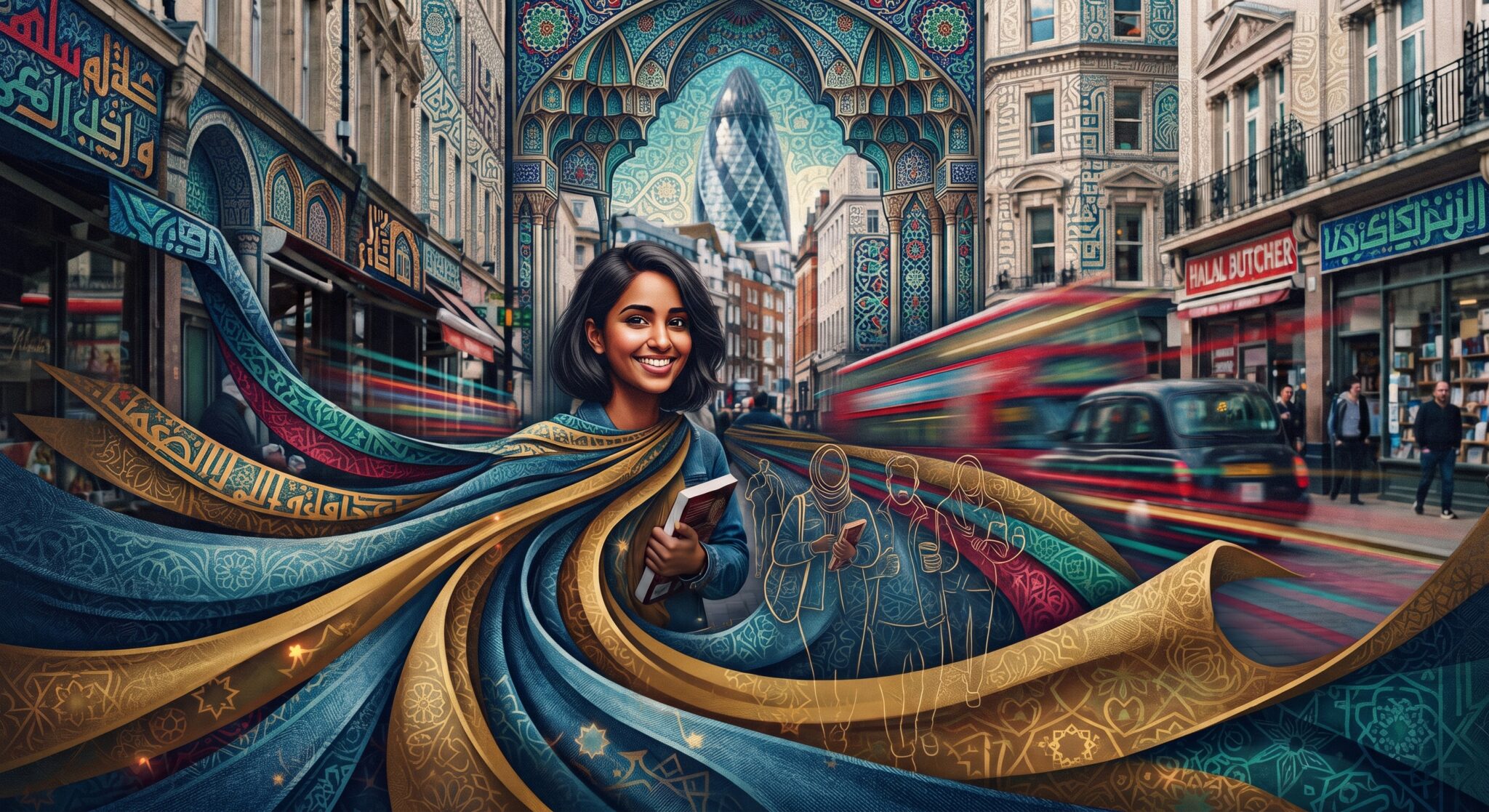
The Foundations of European Islam
Europe does not need to expel Islam, and Islam does not need to conquer Europe; both need a new synthesis. European religious freedom protects both the practice of religion and the freedom to change one’s beliefs, while the European framework is based on human dignity, freedom, equality, democracy and the rule of law.
The key is not to “change Islam to please Europe”, but to create the intellectual, religious and social conditions in which a fully European Islam can exist, compatible with liberal democracy while remaining recognisable to a Muslim.
The project that could transform the relationship between Islam and Europe over the next 50 years
For decades, Europe has debated a seemingly simple question: can Islam fit into Europe?
Perhaps that is the wrong question. The truly important question might be a different one: can a European Islam emerge?
Not an imported Islam. Not an Arab Islam transplanted to Paris, Barcelona, Berlin or Brussels. Not an Islam confined to parallel communities, culturally governed by countries outside Europe and subject to social codes born in very different societies.
We are talking about something far more ambitious: an Islam born in Europe, conceived in Europe, spoken in Europe’s languages and built by European Muslims.
An Islam that can pray in a mosque in Barcelona without feeling foreign. An Islam that can be practised by a woman who studies, works, runs a business and freely decides how to dress.
An Islam that can accept a Muslim leaving the religion without turning that person into an enemy. An Islam that can recognise that the laws of the state take precedence over any religious interpretation.
An Islam that can coexist with atheists, Christians, Jews, agnostics and people of any other belief. And, above all, an Islam that can say: “I am Muslim and European. I do not have to choose.”
1. Europe does not need an Islam without identity
Europe cannot demand that a Muslim stop being Muslim. But neither can it accept a religious interpretation being placed above fundamental rights.
Here lies the real challenge. The aim is not to eliminate Islam. It is to build an Islam that can live within the European framework without demanding permanent exceptions for principles incompatible with it. That is the starting point: Islam with a European identity.
2. The problem is not that Muslims exist in Europe
Islam is already in Europe. There are first-, second- and third-generation European Muslims. And there will increasingly be people for whom Europe is not the place their parents emigrated to.
It will simply be their home. They were born in Barcelona, Paris, Rotterdam, Milan, Marseille or Berlin.
They study at European universities, work for European companies, pay European taxes and vote in European elections. Their children attend European schools.
And yet, in many cases, a large part of their religious, cultural and intellectual reference points still comes from outside Europe. Here lies a historical contradiction.
Europe is producing European Muslims, but it has not yet fully produced a European Islam. And that difference could prove decisive. European Muslims need a European Islam.
3. European Islam would not be a new religion
This is important. The concept of European Islam should not mean creating a new religion. There would be no need to invent another Quran or create another prophet. It would be something different: a new European interpretation of Islam.
The difference may seem small, but it is enormous. European Christianity is not identical to Christianity in the Middle East. European Judaism is not identical to Judaism in other regions.
And a European Muslim in the 21st century does not have to interpret social issues in exactly the same way as a Muslim from the 7th century, the Ottoman Empire or a contemporary Middle Eastern society.
European Islam would therefore be a European Islamic tradition, rooted in the Islamic faith but shaped by European culture.
4. First principle: Civil law takes precedence over religious rules
There must be an absolutely clear boundary here. In Europe, sovereignty belongs to citizens and the democratic state, not to a religious authority, an imam or an interpretation of Sharia.
European Islam would have to fully accept the following principle: Religion can guide a believer’s conscience, but it does not replace democratic legislation.
A Muslim may consider certain behaviour sinful, but cannot demand that it be made illegal simply because their religion considers it wrong.
5. Second principle: Absolute equality between men and women
European Islam would have to embrace one principle without ambiguity: Men and women have exactly the same religious, legal, political and civil dignity.
Europe already establishes equality between women and men as one of its fundamental principles. European Islam would have to embrace this not as a concession to Europe, but as an essential part of its own evolution.
6. Third principle: Freedom of conscience
It is not enough to allow someone to enter a religion; they must also be allowed to leave it. A European Islam genuinely compatible with Europe would have to recognise that a Muslim can stop being Muslim, and no religious authority should have the power to punish them for doing so.
European religious freedom explicitly includes the freedom to change one’s religion or beliefs.
A religion that only works when nobody can leave it does not operate through conviction; it operates through pressure.
7. Fourth principle: Critical thinking
European Islam should fully accept historical, scientific and academic research. The Quran can be studied from a religious perspective.
But it can also be studied historically. Hadiths can be subjected to research. Medieval interpretations can be debated. Great Muslim thinkers can be criticised. And no question should be considered blasphemous.
Europe has developed an intellectual culture based on a simple idea: no authority is above questioning.
The European Charter protects freedom of expression and academic freedom. European Islam will need something akin to an intellectual revolution: moving from a culture of answers to a culture of questions.
8. Fifth principle: Distinguish between text, interpretation, tradition and culture
Not everything historically practised by Muslim societies necessarily originates in religion.
Nor does every religious interpretation carry the same weight.
European Islam would need to teach people to distinguish between the text, its interpretation, historical tradition and cultural custom.
When these concepts are mixed together, reforming anything becomes almost impossible. When they are separated, room for thought emerges.
For example, a particular practice may have been normal a thousand years ago. That does not automatically prove it should remain obligatory today.
A Muslim can believe in God, pray, fast during Ramadan and consider the Quran a sacred text without having to reproduce every social custom of Arabia, Pakistan, Morocco, Turkey, Afghanistan or anywhere else.
Religion travels, and cultures travel too, but they do not have to remain inseparable forever.
9. The emergence of “European imams”
The European imam of the future should not simply be a religious leader trained in another country who subsequently arrives in Europe.
We need a new generation of religious leaders: educated at European universities, fluent in local languages, knowledgeable about European history, trained in fundamental rights and, naturally, equipped with a solid Islamic education.
The imam of the future should be able to discuss the Quran with a believer in the morning and talk to a university professor about Kant, democracy or artificial intelligence in the afternoon. European Islam will have to exist within an integrated intellectual society.
10. European Islam must be national and European at the same time
A European Muslim should not have to choose between saying “I am Muslim” and “I am Spanish”.
They can be both. Identities do not have to compete.
European Islam should gradually abandon the idea that Muslim identity necessarily depends on a country of origin. A Spanish Muslim does not need to live culturally as though they were in Morocco.
A French Muslim does not need to reproduce Algeria. A German Muslim does not need to reproduce Turkey.
Family roots can be preserved while religion develops a new culture. That is precisely what leads us towards European Islam.
11. The great leap: From Muslim immigrant to European citizen
For too long, the European debate has treated Muslims as immigrants. But millions of European Muslims are no longer immigrants; they are citizens. Their children are not immigrants either. They are Europeans.
Here lies a fundamental conceptual shift. The future should not speak only of “Muslims living in Europe”. We should start talking about “European Muslims”.
The difference is enormous. The first concept describes a presence; the second describes an identity.
12. European Islam cannot be a branch office of any foreign state
A European religious community needs autonomy. Its mosques should be transparent. Its leaders should be accountable to their communities. And its religious education should take place within Europe.
European Islam must be economically independent. Financial autonomy will be one of the foundations of intellectual autonomy. Whoever pays for the structure will ultimately influence its ideas.
This does not mean breaking cultural ties with other countries. It means that a European religion cannot be structurally dependent on foreign governments. European Muslims need to develop their own institutions.
13. European Islam will need a new relationship with sexuality and private life
This will probably be one of the most difficult areas. Europe has developed a broad understanding of individual autonomy, including relationships between adults, marriage, divorce, sexual orientation, private life and personal freedom.
14. Why do we need European Islam?
Because there is a reality that will not disappear. Islam is already part of Europe.
The question is no longer whether we want it to exist. The question is: what kind of Islam will exist?
We can have an open, democratic, autonomous and deeply spiritual European Islam, or an Islam rooted in medieval norms, dependent on foreign structures and culturally isolated.
We can have increasingly integrated communities or increasingly separate ones. The future is not written. And that is precisely why we must start discussing it.
We need European Islam because open societies cannot sustain communities disconnected from their fundamental constitutional values. An Islam rooted in Europe ensures that faith does not become a force for isolation, but another component of our civic pluralism.
15. European Islam as a laboratory of civilisation
Imagine Europe in 2050.
Millions of European Muslims. Mosques designed for European cities. Imams trained at European universities.
Muslim women occupying positions of religious, political and business leadership.
Universities studying new currents of European Islamic thought. Theological debates in French, German, Spanish, Italian, Dutch and Catalan.
And something extraordinary: a European Muslim who no longer has to constantly explain how they can be both things at once. Muslim and European.
Europe could become the place where Islam reinvents itself.
It may seem paradoxical, but perhaps the future of Islam will not lie solely in countries where it has historically been the majority religion.
It could also lie in Europe. Why?
Because Europe offers something extraordinarily important: freedom to think.
A religion can transform when its believers are free to study its texts without fear, debate them, compare them with other traditions and develop new interpretations.
16. It will not be a quick process
We should not deceive ourselves. It will not happen in five years, and probably not in ten either. A profound religious transformation may take generations. Societies need time to change.
And there will be resistance. Some Muslims will consider the project a betrayal, while some Europeans will argue that it will never be enough. There will be conflicts, controversies, setbacks and radical movements.
The mistake would be to expect a perfect solution. European Islam will not eliminate every conflict, but it could provide a common framework in which Islam can exist without becoming a social problem.
17. The great pact
We could imagine a historic pact between Muslim citizens and European societies. Its philosophy could be summarised as follows:
Europe guarantees: religious freedom, freedom of worship, protection against discrimination and respect for Muslim communities.
European Islam accepts: democracy, the rule of law, equality between men and women, freedom of conscience, freedom of expression, individual autonomy, separation between religion and political power, and the prohibition of religious violence.
It would be neither Islam’s capitulation nor Europe’s capitulation. It would be a social contract for coexistence.
18. The European Islam manifesto
We could summarise the project in ten principles.
1. God is freely chosen
Faith belongs to the individual’s conscience.
2. The human being comes before the institution
No religious authority can stand above fundamental rights.
3. Democratic law is the common law
Religion can guide the conscience, but it does not replace the state.
4. Men and women have equal dignity
No religious interpretation can justify legal inequality.
5. Nobody can be forced to believe
Freedom of religion includes the freedom to leave a religion.
6. Asking questions is not betrayal
Critical thinking must form part of European Islamic culture.
7. The mosque belongs to the community
Not to a foreign government.
8. Tradition can evolve
Preserving the essence does not mean freezing history.
9. Being Muslim and European are not incompatible identities
They can come together to form a new identity.
10. The future belongs to European Muslims
Not to those who speak on their behalf from outside Europe.
EUROPEAN ISLAM
An ancient religion entering a new civilisation. And perhaps one of the great cultural experiments of the 21st century.
European Islam is the only realistic solution because it demonstrates that modernity does not belong to a single culture, and that Islam is capable of evolving, engaging in dialogue and fitting into the framework of advanced democracies. It is not a naive utopia; it is an unavoidable historical necessity for safeguarding peace, freedom and cohesion in tomorrow’s Europe.
We are not reforming the past; we are designing the future. European Islam does not yet fully exist, but its first elements are already here.