
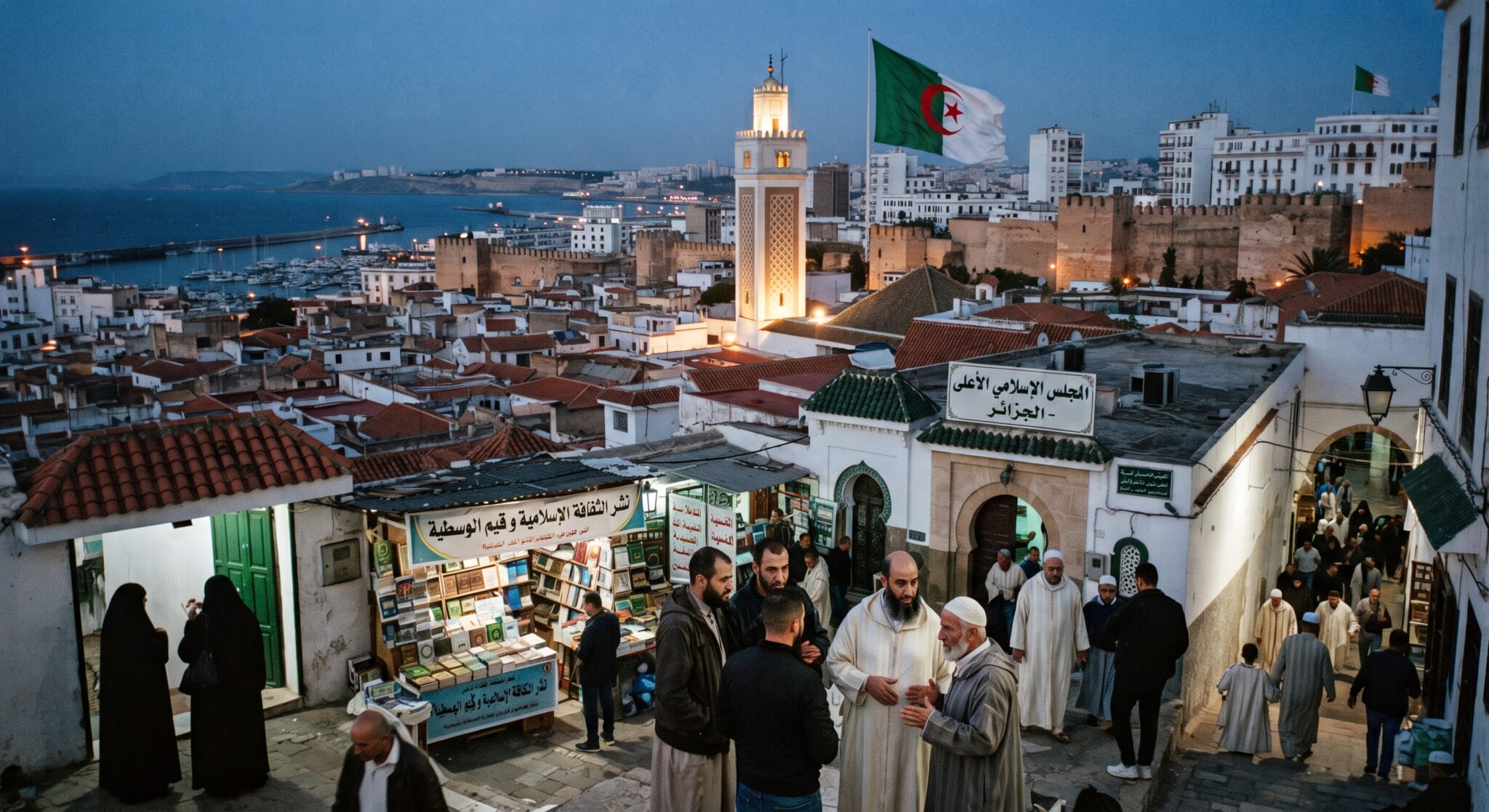
To Understand Islam in Europe, We Must Look at Its Roots
To understand Islam in Europe, we must look beyond Europe’s borders.
The Islam we encounter in Europe today did not originate in Europe. Its ideas, religious currents, institutions, leaders and many of its organisational structures have their roots in countries where Islam is the majority religion.
Therefore, if we want to understand what kind of Islam is reaching Europe, where it comes from, who represents it and what influence it may have, we must first understand what is happening in its countries of origin.
There is no single Islam. There are different currents, religious schools, organisations and interpretations. There are also significant differences between countries. Islam in Egypt is not exactly the same as Islam in Algeria, Morocco, Saudi Arabia, Turkey or the Gulf countries.
Furthermore, religion does not always operate independently of political power. In many Muslim countries, religious institutions maintain important relationships with the state, governments, the military, businesspeople and various social organisations. These relationships can influence how Islam is interpreted and transmitted.
Some of this influence can reach Europe through mosques, associations, religious organisations, funding, educational centres, religious leaders, international networks or immigrant communities.
That is why studying Islam in Europe without also examining its roots can lead to an incomplete picture.
The question is not simply, “What kind of Islam exists in Europe?”
We must also ask: Where does it come from? Who funds it? Who represents it? What institutions stand behind it? Which religious current does it promote? What relationship does it maintain with the political power of its country of origin? And how does it change when it reaches Europe?
In this series of articles, we will analyse precisely this ecosystem.
Country by country, we will examine religious institutions, major currents, who holds power within them, how they are funded, what relationships they maintain with politicians, businesspeople and other power structures, and what connections may exist with Europe.
The objective is to understand their roots in order to better understand their presence in Europe. Because to engage properly with any phenomenon, we must first understand how it works, where it comes from and who its main actors are.
Religion, the State, the Military, Business and Foreign Influence
The ecosystem of Islamic power in Algeria has been profoundly shaped by the country’s recent history. Unlike other countries where religion is one of several tools of government, in Algeria control over religious affairs is a matter of national security and state survival. This is due to the trauma of the civil war of the 1990s, known as the “Black Decade”, which pitted the army against radical Islamist guerrillas.
In Algeria, Islam is not simply a force seeking to control the state; it is also an instrument the state itself uses to control and organise the religious sphere.
The Constitution establishes Islam as the state religion and creates a High Islamic Council linked to the Presidency. The state also funds mosques and pays the salaries of imams and other religious personnel.
Who Really Controls Islam in Algeria?
When discussing Islamic power in Algeria, we can make a mistake from the outset. We might imagine a single bloc called “Islamic power” seeking to control the state.
The reality is considerably more complicated. In Algeria, Islam is deeply integrated into the state. The Constitution establishes that “Islam is the religion of the state”. At the same time, the political system maintains strong control over religious institutions.
Therefore, the interesting question is not simply how much power Islam has in Algeria, but who controls Islam, who controls the state and how these two forms of power interact.
A third fundamental actor then enters the picture: THE MILITARY.
To understand Algeria, we must analyse the following together:
- The Presidency
- The military
- The security services
- The Ministry of Religious Affairs
- The High Islamic Council
- Mosques and imams
- Businesspeople
- The hydrocarbon industry
- Political parties
- Civil society
The result is one of the most complex power ecosystems in the Maghreb.
ALGERIA: A STATE WHERE ISLAM IS PART OF NATIONAL IDENTITY
Algeria is not a secular state in the strictest French sense. Islam enjoys special constitutional recognition. The Constitution establishes Islam as the state religion and also provides for a High Islamic Council linked to the Presidency. This means that religion forms part of the state’s official identity.
However, there is a fundamental difference between Algeria and countries where religious organisations enjoy much greater autonomy: the Algerian state controls a large part of the religious infrastructure.
This is not simply a case of the state on one side and religion on the other. It is a system of state + institutionalised religion.
WHO IS IN CHARGE?
In the current political system, President Abdelmadjid Tebboune is the central figure. But analysing Algeria solely through the Presidency would be insufficient.
For decades, the military has been one of the country’s major centres of power. Since independence from France in 1962, the armed forces have played a fundamental role in Algeria’s political architecture.
The military sees itself as one of the principal guardians of sovereignty, the state, stability and national security.
Various analyses of Algerian politics have pointed out that relations between the Presidency and the military establishment remain fundamental to understanding the country’s strategic decisions.
THE MILITARY: THE GREAT INVISIBLE POWER
In Algeria, there is an important difference between constitutional power and actual power.
Constitutionally, the president occupies the central position. Historically, however, the military has been able to exert decisive influence over almost everything. For this reason, some analysts believe that the Algerian system cannot be understood without examining the relationship between the Presidency + the military.
THE HIRAK MOVEMENT CHANGED THE BALANCE
In 2019, millions of Algerians took to the streets. The HIRAK movement ultimately forced the departure of then-President Abdelaziz Bouteflika.
But the protests were not simply calling for a change of president. They also challenged the political elite, the system, corruption and military influence.
The result was a controlled transition.
Abdelmadjid Tebboune became president, but the military remained a central actor. Some European analyses have described Tebboune’s election as a reconfiguration of the political-military elite’s power rather than a complete break with the previous system.
WHERE DOES ISLAM FIT IN?
This is where things become particularly interesting.
The Algerian state has an enormous interest in controlling the religious sphere. Why? Because Algeria experienced one of the most traumatic episodes of political Islamisation in the late twentieth century.
The Civil War of the 1990s
The confrontation between the state and various Islamist and jihadist groups resulted in enormous violence and left a profound mark on the country.
Since then, the Algerian state has also considered religious radicalisation a national security issue.
THE STATE LEARNED A LESSON
The lesson was roughly this: never allow the religious sphere to fall completely outside state control.
Algeria therefore developed a strong institutional structure governing mosques, imams, sermons, religious training, associations, fatwas and Islamic education.
THE MINISTRY OF RELIGIOUS AFFAIRS
One of the main actors is the Ministry of Religious Affairs and Wakfs. This ministry plays a fundamental role in administering institutional Islam.
Among other responsibilities, it supervises mosques, manages religious personnel, participates in imam training, administers religious assets, organises religious activities and intervenes in matters relating to official doctrine.
There is one particularly important element: the state pays imams. Regulations establish that the Ministry of Religious Affairs provides financial support to mosques and pays the salaries of imams and other religious workers, including social benefits.
This has a very important consequence: a mosque’s imam is not simply an independent religious leader. He forms part of an institutional structure.
THE IMAM AS A STATE EMPLOYEE
This characteristic distinguishes Algeria from several other Islamic ecosystems. The state selects, trains and controls imams.
Legislation establishes that only imams authorised by the government may lead certain religious activities in mosques.
The chain is therefore fundamental to understanding the system:
Mosque → Imam → Ministry of Religious Affairs → State.
THE FRIDAY SERMON
The Friday sermon is one of the most sensitive areas. Why?
A mosque can bring together hundreds or thousands of people, and a preacher can influence opinions, behaviour, political attitudes, identity and social conflicts.
For this reason, the state maintains strong control over religious content.
Legislation allows the state to intervene in mosque activities and penalise certain forms of unauthorised preaching.
THE HIGH ISLAMIC COUNCIL
This is another fundamental actor. The Constitution establishes this body alongside the Presidency. Its functions include issuing opinions on religious matters and submitting reports to the president.
Its members are appointed by the president.
This is extremely important because it demonstrates that the highest institutional religious authority does not operate as a power independent of the state.
WHAT ABOUT FATWAS?
There is also an official structure dealing with fatwas.
In 2025, the Minister of Religious Affairs chaired a meeting of the Ministerial Fatwa Commission specifically devoted to digital challenges and the role of Islamic scholars and imams in responding to interpretations considered contrary to the national religious tradition.
This demonstrates that the state does not want to leave the marketplace of religious interpretations completely unrestricted. Its objective is to protect what it calls the “national religious reference”.
WHAT IS THE ALGERIAN RELIGIOUS TRADITION?
Here we encounter another key concept: Algeria seeks to promote a national religious identity.
Traditionally, this identity has been associated primarily with Sunni Islam, the Maliki school of jurisprudence, the Maghrebi religious tradition and certain interpretations considered compatible with the Algerian state.
The objective is to prevent foreign religious movements from taking over the religious sphere entirely.
FEAR OF FOREIGN INFLUENCES
Algeria has a complicated history with different Islamic currents. For this reason, the state closely monitors:
- Salafism
- Political Islamism
- Jihadism
- Foreign funding
- Foreign preachers
- Imported religious literature
Legislation imposes restrictions on foreign funding for religious associations and on the importation of certain religious materials.
ALGERIA DOES NOT WANT ANOTHER 1991
To understand current religious policy, we must remember the Islamic Salvation Front (FIS).
In 1991, the FIS achieved a significant electoral victory. The electoral process was interrupted, and a decade of violence followed. The conflict ultimately developed into a war between the state and armed Islamist groups.
The outcome was traumatic.
For this reason, the Algerian state developed a policy of “never again”.
POLITICAL ISLAMISM AFTER THE WAR
Since then, the political system has sought to prevent a religious movement from becoming an organisation capable of challenging the state once again.
The Constitution and laws prohibit the creation of political parties based on religion.
This does not mean religion has disappeared from politics. Quite the opposite.
Religion remains an important part of national identity, legitimacy and public discourse, but the state seeks to maintain the initiative.
THE GREAT PARADOX OF THE ALGERIAN SYSTEM
Here we encounter a fascinating paradox: the state controls Islam precisely because it considers Islam potentially dangerous in political terms.
That is why it controls mosques, imams, training, part of the religious publishing sector, funding and religious institutions.
The stated objective is to protect stability. But the result is also an institutional form of Islam that is highly dependent on the state.
WHAT ABOUT BUSINESSPEOPLE?
Here we need to distinguish between two worlds.
THE FORMAL ECONOMY
Algeria has major state-owned and strategic companies, particularly Sonatrach and Sonelgaz, alongside numerous other companies linked to the state.
The hydrocarbon sector remains fundamental. Between 2020 and 2024, it accounted for approximately 13% of GDP, 84% of exports and almost half of budget revenues.
SONATRACH
To understand Algeria’s economic power, we must look at its state-owned energy company, one of the country’s major economic institutions.
Oil and gas generate revenue, foreign currency, public spending capacity and international influence.
THE ALGERIAN BUSINESSPERSON AND THE STATE
For decades, business success in Algeria was closely linked to connections with the state, ministries, public companies, the administration and political networks.
The system has undergone reforms and is seeking to increase private investment, but the state’s influence remains enormous.
The World Bank points out that state-owned enterprises continue to play an important role across numerous sectors.
CORRUPTION AS PART OF THE ECOSYSTEM
To understand the relationship between politicians, businesspeople, officials and public companies, we must also examine corruption.
After 2019, legal proceedings were brought against numerous businesspeople and figures associated with Bouteflika’s former inner circle.
This demonstrates that the economy and politics cannot be analysed separately.
WHAT DOES ALL THIS HAVE TO DO WITH ISLAM?
At first glance, not much. In reality, however, there is a connection.
The state needs legitimacy, and in Algeria that legitimacy comes from several sources: nationalism, the 1954–1962 revolution, the military, Islam and Arab identity.
Islam is one of the components of this architecture.
ISLAM + NATIONALISM
Algeria does not base its identity exclusively on religion.
There is also a strong national narrative: Algeria defeated French colonialism.
The war of independence is one of the state’s main sources of legitimacy. For this reason, the system combines nationalism, Islam, sovereignty and the military.
This combination is extremely important for understanding Algerian politics.
RELIGIOUS POWER ABROAD
Algeria also uses religion as an instrument of diplomacy.
One example is the GREAT MOSQUE OF ALGIERS.
Djamaa el-Djazaïr is much more than a religious building. It is also a national symbol, a religious centre, a cultural instrument and a diplomatic space.
In 2025, for example, it received Spain’s Minister of the Interior and foreign diplomatic representatives. This demonstrates that the Grand Mosque also functions as a space for religious diplomacy.
ALGERIA WANTS TO BECOME A RELIGIOUS POWER IN THE MAGHREB
The Algerian model seeks to project its own religious tradition.
For example, in 2025 it organised an international symposium devoted to the Maliki school, with scholars from several Muslim countries participating.
This is not simply theology. It is also SOFT POWER.
Algeria is effectively saying: “We, too, are a centre of religious knowledge in the Maghreb.”
WHAT ABOUT THE SALAFISTS?
Algeria has also had to confront various Salafist currents.
The Algerian state, however, has a strong interest in preventing any religious current from becoming an independent political structure capable of challenging its authority.
WHERE DOES REAL POWER LIE?
One simple way of explaining the situation is this: in Algeria, religious power is much more subordinate to political and security power than it is in some other Muslim countries.
This is not a system in which Islamic scholars govern the state. It is a system in which the state seeks to govern the religious sphere.
Behind the state lies a power structure in which the military has historically wielded extraordinary influence.
WHAT DOES THIS MEAN FOR EUROPE?
Algeria can affect Europe in at least six areas:
- Energy
- Migration
- Terrorism
- Security
- Islam
- Mediterranean stability
The European Union itself considers Algeria an important partner in energy, the economy, trade and regional security, and has expanded cooperation on migration and counterterrorism.
THE ALGERIAN DIASPORA
Millions of people of Algerian origin live in Europe, particularly in France, Spain, Italy, Belgium and other countries.
This creates family, economic, cultural, religious and political connections.
RELIGIOUS INFLUENCE
Algeria can project influence through imams, religious institutions, mosques, training programmes and religious diplomacy.
However, its model differs from Morocco’s. Morocco has developed a particularly visible strategy involving imam training and religious diplomacy. Algeria places greater emphasis on state control over its national religious tradition.
CONCLUSION
ALGERIA IS NOT A THEOCRACY, and this point must be made absolutely clear.
Algeria is not an Islamic state in the classical sense.
It is a republic in which Islam is the state religion, but the state exercises strong control over religious institutions. Islam forms part of its political architecture.
In Algeria, Islamic power does not primarily consist of religious authorities controlling the state. Rather, it consists of the state controlling much of the religious sphere and using Islam as a component of national identity, legitimacy and stability.
This model emerged largely from the traumatic experience of the 1990s. The state learned that leaving the religious sphere completely open could allow a political force to emerge that might challenge its authority.
Since then, the objective has been to CONTROL THE RELIGIOUS SPHERE BEFORE ANOTHER POWER CAN CONTROL IT.
The question is not, “Can Algeria Islamise Europe?” That would be far too simplistic.
The truly interesting question is: How far can the influence of a state extend when it combines religion, the military, energy, migration, diplomacy and a significant European diaspora?