
The Hijab Takes to the Pitch: Religious Freedom, Integration or a New Political Battleground?
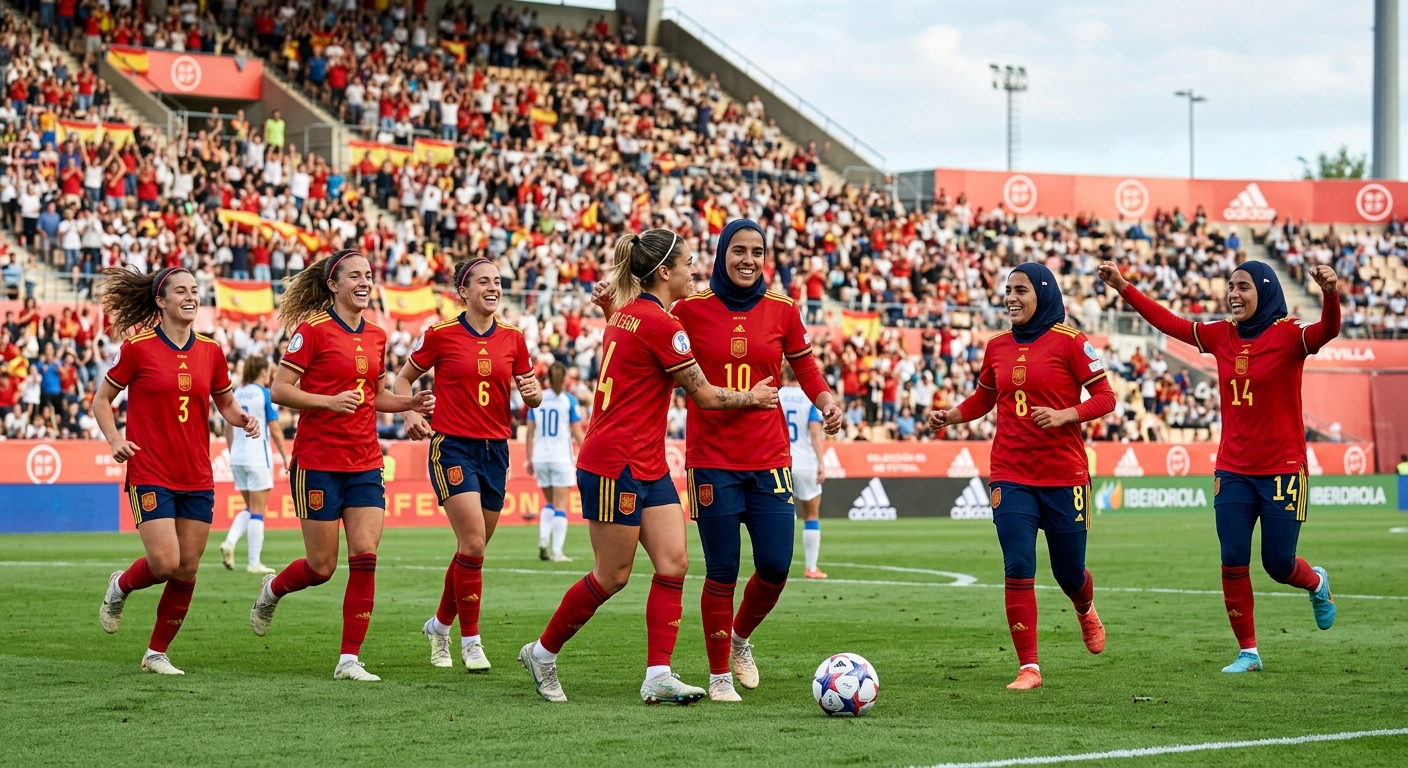
Imagine this scene. A footballer walks onto the pitch. She is wearing the Spanish national team shirt, greets her teammates and gets ready to play. She runs, passes the ball and scores a goal.
So far, everything is normal. But there is one detail that catches the eye: she is wearing a hijab, a headscarf that covers her hair and neck.
And then the match begins… and so does the debate.
Some people say: “Perfect! It is an expression of diversity and religious freedom.”
Others respond: “Hold on. What role should religion play in a national team?”
And some, as always, turn a football match into a cultural battle of Olympic proportions.
The question is simple, but the answer is not: should an athlete be allowed to play wearing a hijab, or can sporting institutions set limits?
Shouting “freedom” or “ban” is not enough. We need to talk about rights, rules, safety, equality and personal autonomy.
And yes, we also need to talk about religion without tiptoeing around it as if we were crossing a minefield.
First, let’s call things by their proper names
Before entering the debate, let’s clarify what the hijab is.
The hijab is a garment that usually covers the hair and neck while leaving the face visible. Some women wear it for religious reasons; others associate it with their identity, culture or personal beliefs.
And not everything that covers the body is the same.
Hijab: Usually covers the hair and neck but leaves the face uncovered.
Niqab: Covers the face, usually leaving the eyes visible.
Burqa: Covers the body and face, normally with a mesh screen through which the wearer can see.
We should not lump everything together. If we cannot distinguish between these garments, it will be difficult to discuss their implications.
Imagine a player in the Spanish national team
Think of a footballer born in Spain. She grew up in a Spanish neighbourhood, played for youth teams, trained for years and, after a great deal of effort, receives a phone call: “Congratulations! You have been selected for the senior national team.”
The player has talent, discipline and the ability to compete at the highest level. She also wears a hijab. When she steps onto the pitch, she represents Spain just like her teammates. Her religion does not diminish her nationality, talent or hard work.
But several questions arise:
Should wearing a hijab prevent her from playing? Can a federation require religious neutrality in players’ appearance? Should a national team allow visible religious symbols? And who decides exactly what neutrality means?
This is where things become complicated.
A woman can be Spanish and Muslim at the same time. She can also be French, German or Dutch and have a religious identity.
The real question is not whether these identities can coexist. It is whether a sporting institution can restrict an athlete’s religious expression and, if so, for what reason, to what extent and under which rules.
What does it mean to see the hijab in a national team?
A player wearing a headscarf with the shirt of a European national team can be interpreted in two completely opposite ways.
The inclusive perspective: For some people, seeing an athlete wearing a hijab representing a European country is a natural reflection of a pluralistic Europe. It conveys the message that people do not have to abandon their religious identity to be fully European and compete at the highest level.
The critical perspective: Those who advocate a vision of secularism or universalist feminism argue that the national team represents the state and all its citizens. From this perspective, displaying a religious symbol in that institutional setting undermines the team’s neutrality and makes visible a garment that many women around the world are forced to wear.
France: When the hijab meets the rulebook
France is one of the most interesting cases.
The French Football Federation introduced a rule banning certain garments or signs that visibly express political, philosophical, religious or trade-union affiliation during matches.
In June 2023, the French Council of State upheld the legality of this ban in competitions organised or authorised by the federation.
The court considered that the federation could establish dress rules to ensure the proper conduct of matches and prevent disputes or confrontations unrelated to sport.
In short, in this context, France allows the use of the hijab to be restricted during matches covered by those rules.
But that is not the end of the story. In reality, it is where the debate begins.
Because a court finding a rule lawful does not mean that society as a whole agrees with it.
And the inevitable question arises: if a woman can wear a hijab in the street, at university or in other settings, why can she not wear it during a football match?
The French approach is based on the neutrality of the competition and the federation’s authority to regulate it.
Critics, however, question whether the restriction excessively limits religious freedom and participation in sport.
There is no magic phrase that resolves the issue. The law, the context and the consequences all need to be examined.
International football has already opened the door
This debate did not begin yesterday.
International football rules have evolved to allow certain types of head coverings, provided they meet safety and equipment requirements.
In 2016, FIFA announced changes that facilitated the wearing of headscarves in football. That same year, Jordan hosted the FIFA U-17 Women’s World Cup, an important precedent for the participation of players wearing hijab.
And something historic happened at the 2023 Women’s World Cup.
Moroccan footballer Nouhaila Benzina became the first player to compete in a FIFA Women’s World Cup match wearing a hijab.
The message was clear: the hijab can coexist with international football when the applicable rules allow it and safety requirements are met.
But be careful, because a common misunderstanding often arises here.
The fact that an international rule permits a garment does not mean that all national federations have exactly the same regulations.
FIFA can establish general rules while each country maintains its own legal and institutional framework.
Therefore, allowing the hijab in one competition does not automatically oblige every institution to regulate it in the same way in every circumstance.
Does allowing the hijab help integration?
This brings us to one of the most important questions.
A Muslim girl wants to play football. She loves running, competing and scoring goals. Perhaps she dreams of playing in a major stadium.
If she wears a hijab by choice and the rules allow it, she can continue her sporting career without having to choose between her religious practice and her passion.
This could encourage greater participation by girls and women, create new sporting role models, foster contact between people from different backgrounds and increase the presence of Muslim women in elite competitions.
A footballer wearing a hijab could become a role model for a girl who had never imagined herself playing for a national team.
But we need to be precise. Allowing the hijab may facilitate participation for some women. It does not automatically prove that any policy allowing it will solve every integration problem.
Integration does not depend on a single garment. Education, economic circumstances, families, opportunities and potential social pressures also play a role.
Football can open a door. But we must then establish whether that door leads to an open field or to another corridor full of obstacles.
Why do some people support a ban?
Those who support restrictions in certain contexts usually put forward several arguments.
For example:
-
Sporting institutions need common rules.
-
National teams have a symbolic dimension.
-
Some federations defend a specific form of neutrality.
-
Rules should be applied consistently to different symbols and forms of expression.
-
Sport should prevent political or religious conflicts from spilling onto the pitch.
In France, the Council of State considered that the federation could impose restrictions on clothing in the circumstances under examination.
The uncomfortable question of women’s freedom
The hijab also raises questions about equality between men and women.
In some religious interpretations, it is presented as a specific obligation for women. In other contexts, women understand it as a personal choice connected to faith, identity or modesty.
Europe must be able to debate these issues.
It must be able to ask whether family, community or institutional pressures exist. It must be able to examine religious rules that affect women.
The downside: When the headscarf eclipses the athlete
Sport should be about goals, speed, technique and effort.
But when a player wears a hijab, there is a risk that everything else disappears.
Instead of discussing her performance, some people will talk only about the headscarf.
If she scores three goals:
“What a great player!”
But if she wears a hijab, the conversation may turn into a debate about religion, identity and politics.
The athlete risks becoming a symbol rather than a person.
And this can happen in both directions.
Some may use her as proof that integration is an absolute success.
Others may present her as a sign that Europe is losing its identity.
The football pitch as a cultural battleground
Football has an extraordinary ability to stir emotions.
A final can bring people to tears. A penalty can divide a family. And a refereeing decision can turn calm people into international experts on conspiracy theories.
It is therefore hardly surprising that the hijab can also become a political symbol.
Different groups may use the image of a player to defend their own positions.
Some may present her as an example of diversity.
Others may portray her as a symbol of supposed religious expansion.
But we need to be careful.
Seeing a woman wearing a hijab playing football does not, in itself, prove that an ideological expansion strategy exists.
Likewise, questioning the wearing of the hijab does not prove that someone is Islamophobic.
Should a national team be completely neutral?
Here we encounter another complicated issue.
National teams are not just any sporting clubs. They have anthems, flags, crests, shirts and ceremonies.
They represent a country, even though they cannot represent all its diversity.
For this reason, some people believe that a national team should maintain a religiously neutral appearance.
Others believe that a national team should reflect precisely the diversity of the citizens who make up the country.
Both positions can be debated.
But several things need to be distinguished: national identity, individual religious expression, political propaganda, safety rules and the organisation of the competition. They are not exactly the same thing.
A player can represent Spain without having to abandon her religion. And an institution can have rules on clothing without that necessarily meaning that all religious expression is a threat.
Spain, France, Germany and the Netherlands: Four different scenarios
Imagine four situations.
Spain: A diverse national team
A Spanish Muslim player wears a hijab and is selected for the national team.
The discussion would focus on the applicable regulations, religious freedom and how the institution understands national representation.
France: Institutional neutrality
France provides a specific case because the French Football Federation maintains restrictions on religious symbols during matches covered by its rules.
The Council of State upheld their legality in 2023.
Germany: Diversity and common rules
A national team that allows sports hijabs could demonstrate an understanding of national identity compatible with different religious practices.
The Netherlands: Equal participation
In this case, the debate could focus on whether access to sport is genuinely equal for all women and whether there are barriers that particularly affect certain athletes.
These examples do not mean that all countries have the same laws or that their federations operate in identical ways.
They help us raise a question: should there be common rules across Europe, or should each country decide according to its own legal framework and understanding of neutrality?
Is this about freedom or the expansion of Islam?
The presence of a player wearing a hijab can be interpreted in different ways.
It may be an expression of individual religious freedom and a reflection of society’s diversity.
An ideological expansion strategy cannot be demonstrated simply because an athlete wears a headscarf.
But neither should we abandon the investigation of whether organisations are trying to influence sporting policies, institutions or public opinion.
What should sporting institutions do?
Federations have the right to establish rules.
They must ensure safety, the proper organisation of matches, appropriate equipment and the conduct of participants.
The question is not whether they can regulate. The question is how far they can go when a rule affects an athlete’s religious freedom.
The central question: Who decides how a woman should dress?
Perhaps the deepest question is not:
“Hijab: yes or no?”
Perhaps it is this:
Who has the right to decide how a woman should dress in order to participate in public life?
Many people and institutions may influence that decision: the athlete herself, her family, her social environment, religious institutions, sporting federations, courts and public opinion. Each has a different degree of influence.
A liberal democracy must protect women’s ability to make decisions about their own lives. But it must also recognise…
What effects could this have on Europe?
There is no single inevitable consequence of allowing or restricting the hijab in sport.
The effects depend on the regulations, the country, society and how the decision is implemented.
Europe needs more than two automatic answers
Two statements often appear in this debate, oversimplifying everything.
The first: “Everything related to the hijab is oppression.”
The second: “Every restriction on the hijab is Islamophobia.”
The problem is that both responses can prevent us from examining individual cases.
Some women wear the hijab out of conviction. Some may face pressure. Some institutions have justified rules, while others may need to review theirs.
Not everything is black and white.
Conclusion: Don’t let the hijab become the referee of the match
The hijab in European sport is not merely a question of clothing.
It is where religious freedom, women’s autonomy, sporting rules, national identity and the debate about Islam in Europe intersect.
A player wearing a hijab can be an elite athlete, a European citizen and a woman with her own convictions.
She should not automatically become proof that integration is succeeding or failing.
Nor should we turn a blind eye to legitimate questions about religious pressure, gender equality and the rules governing institutions.
The real challenge is to build a society where a woman can participate in sport without being automatically excluded because of her religion, but where she can also change her mind without facing pressure.
Because, in the end, football should be decided by goals, not cultural wars.
Is allowing the hijab in European national teams an expression of individual freedom, or are there circumstances in which sporting institutions should set limits to protect safety, equality and common rules?
And a second question, perhaps even more uncomfortable: do we truly defend women’s freedom when they can choose to wear the hijab, but also when they decide to take it off?