
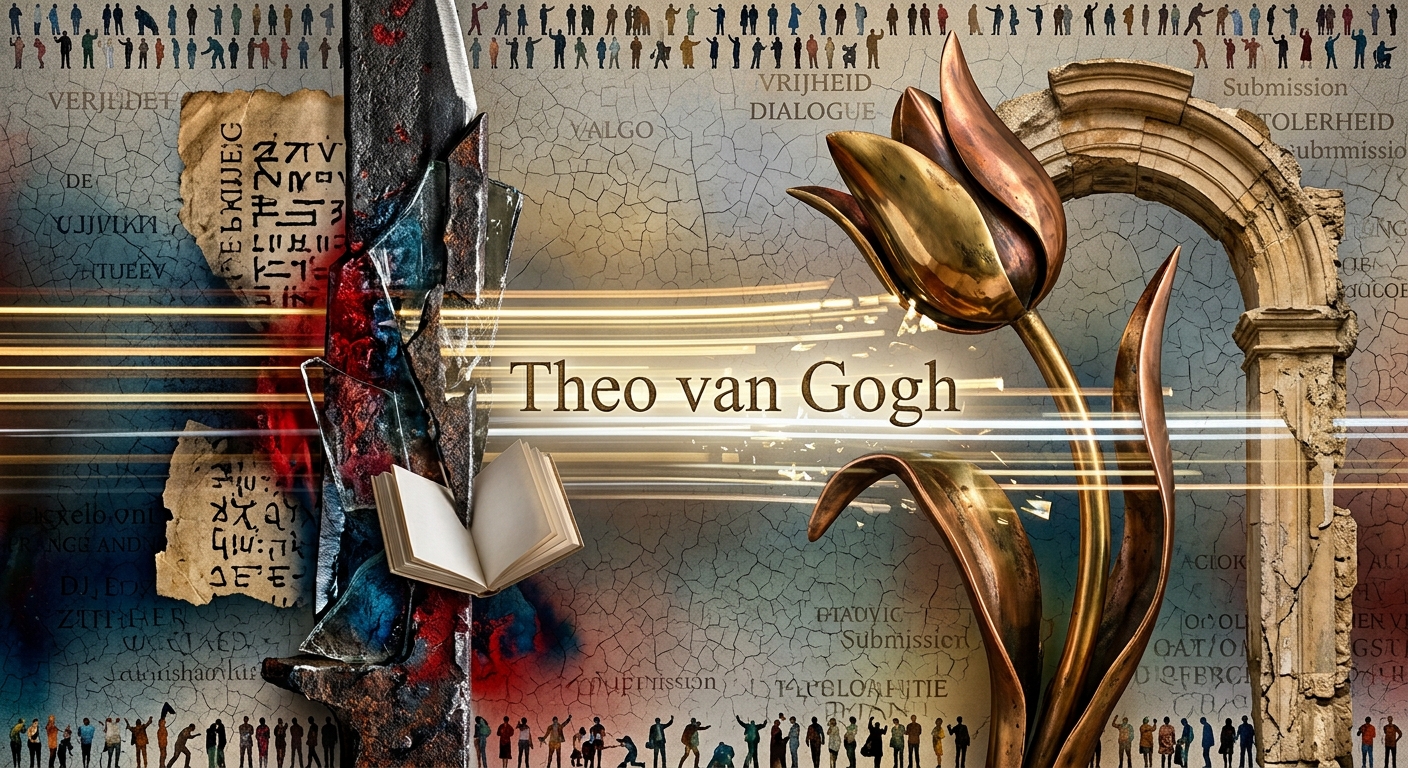
Theo van Gogh: The filmmaker murdered for criticizing Islam
Series: Attacks against thinkers and journalists in Europe · Article 2
On November 2, 2004, a crime shocked the Netherlands and redefined the alarms surrounding Islamic extremism in Europe. Filmmaker and writer Theo van Gogh was brutally executed in broad daylight in Amsterdam. This attack not only took the life of one of the country’s most provocative voices, but also shattered the historical image of the Netherlands as an unwavering model of tolerance and multiculturalism.
1. A death that seemed impossible in the Netherlands
The Netherlands had a reputation for being a tolerant, liberal society accustomed to debating almost any topic: religion, sex, politics, immigration, the monarchy, or freedom of expression.
Amsterdam was one of the symbols of that culture. People from diverse backgrounds and beliefs lived together in its streets. The country had a long tradition of freedom of speech and criticism of religious institutions.
However, that image of tolerance harbored underlying tensions and issues.
During the years preceding the murder, the debate regarding immigration, the integration of citizens of Muslim background, and the role of Islam in Dutch society had become increasingly intense. The assassination of politician Pim Fortuyn in 2002 had already shown that political violence could strike the Netherlands.
Two years later, the death of Theo van Gogh revealed something even more severe: a citizen could be murdered for his artistic work and for the ideas he advocated or disseminated.
2. Who was Theo van Gogh?
Theo van Gogh was born on July 23, 1957, in Wassenaar, the Netherlands. He was a filmmaker, writer, columnist, and a public figure known for his provocative opinions.
He died at the age of 47.
He was a descendant of the family of the painter Vincent van Gogh, although his career developed in film, television, and opinion journalism.
Van Gogh was not a moderate intellectual in the traditional sense. His style was direct, aggressive, and mocking. He criticized politicians, religious figures, and social groups.
In a democracy, a person may use unpleasant language, make mistakes, or provoke. The permissible responses are criticism, satire, and debate. Murder cannot become a mechanism to dictate which opinions are allowed.
3. Ayaan Hirsi Ali and the film Submission
The central element of this story was the short film Submission: Part 1, broadcast on Dutch public television on August 29, 2004.
The film was written by Ayaan Hirsi Ali and directed by Theo van Gogh. Hirsi Ali, of Somali origin, was a member of the Dutch Parliament at the time and a well-known critic of certain aspects of the Islamic religion and practices that justify the subordination of women.
The film lasted approximately ten minutes. It portrayed women recounting experiences of abuse, violence, and subjugation. Verses from the Quran were projected onto the protagonists’ bodies, aiming to establish a critical link between specific religious texts and violence against women.
What was the film aiming to denounce?
Hirsi Ali contended that certain interpretations of Islamic texts could be used to justify violence against women. Her objective was to denounce that link and open a public debate.
The film sparked criticism and protests. Some Muslims and organizations considered that the work attacked Islam as a whole and presented an unfair image of believers.
Here it is necessary to introduce a distinction:
-
A critique of a religion is part of the debate of ideas.
-
A threat or murder motivated by religion is criminal violence.
A religion cannot be used as an excuse to eliminate the freedom of those who criticize it.
It is also legitimate to critically analyze the film. One may question its simplification, its way of linking religious texts to social behavior, or its focus on Muslim women. But a film critique is not a authorization to kill its director.
The problem some preferred not to discuss
The film raised an uncomfortable question: Can a society criticize religious interpretations that affect women’s rights?
The answer in a liberal democracy should be yes. Criticism may be unfair, exaggerated, or provocative, but it must be allowed to be expressed and debated.
The problem arises when a group expects its sacred texts, symbols, or leaders to remain beyond any public criticism, and further attempts to enforce that protection through threats.
4. Threats before the murder
Following the broadcast of Submission, tension escalated.
Ayaan Hirsi Ali had already received threats prior to the film and required protection. After the broadcast, authorities reinforced security measures around her.
Theo van Gogh also received threats, though his attitude toward police protection was different. He continued to move about publicly and maintained his provocative style.
A Dutch government document records that, following the film’s broadcast, authorities became aware of online messages containing threats against both Hirsi Ali and Van Gogh.
The question that lingered after the attack is uncomfortable: Were the threats against Theo van Gogh taken seriously enough?
To answer with rigor, one would need to examine threat assessment reports, protection decisions, the information available at the time, and coordination among security agencies.
However, one reality is evident: the threats were not merely internet discussions; they ultimately culminated in murder.
5. The day of the murder: November 2, 2004
On the morning of November 2, 2004, Theo van Gogh was riding his bicycle along Linnaeusstraat in Amsterdam.
It was approximately eight-thirty or nine in the morning. The street was busy with people commuting to work.
-
The initial shots: Mohammed Bouyeri, a 26-year-old man holding dual Dutch and Moroccan nationality, stepped out armed with a handgun. He fired repeatedly at Van Gogh, who fell wounded from his bicycle.
-
Desperate plea: Van Gogh attempted to cross to the opposite sidewalk and implored his attacker: “Can’t we talk about this?”
-
Gruesome death: Without a word, the attacker executed the filmmaker at point-blank range. Immediately after, he drew a machete with which he attempted to decapitate the victim and finally plunged a large kitchen knife into his chest.
-
The manifesto-letter: Along with the knife, Bouyeri left a five-page letter pinned to Van Gogh’s body. The letter contained direct death threats against Ayaan Hirsi Ali, Dutch politicians, and Western governments.
08:45 AM ──► Terrorist fires shots at Van Gogh riding his bicycle
08:47 AM ──► Attempted escape and execution at point-blank range in the middle of the street
08:50 AM ──► Ritual throat-slitting and letter pinned to the chest with a knife
09:15 AM ──► Shootout with police and arrest of the murderer
How many victims were there?
The fatal victim was:
-
Theo van Gogh, Dutch filmmaker, writer, and columnist.
During the attack and the murderer’s arrest, situations of danger and violence also arose against police officers and bystanders who were injured by gunfire. The judicial process included charges related to attempted murder and other offenses, in addition to the murder of Van Gogh.
The primary fatal victim was Theo van Gogh. The gravity of the crime also lay in its political nature, its intimidating intent, and the threats directed at other individuals.
6. Who was the murderer?
The perpetrator was Mohammed Bouyeri, who was born and raised in the Netherlands. Despite having integrated well during his youth, he underwent rapid radicalization through the Hofstad Network (Hofstadnetwerk), a local jihadist cell composed of radicalized local youths.
He was 26 years old when he committed the murder and 27 when he was convicted.
Did he act alone?
Bouyeri was the physical perpetrator of the murder. The investigation analyzed his connections with other radicals and the potential existence of a terrorist structure.
However, the 2005 verdict did not establish that others had directly collaborated with him in the murder of Van Gogh.
7. Motives behind the attack
The motives for the murder were religious and ideological in nature.
Bouyeri considered Theo van Gogh an enemy of Islam due to his participation in Submission and his public opinions. The letter left on the victim’s body contained threats against Ayaan Hirsi Ali and expressed an extremist worldview that presented violence as a religious duty.
During the trial, Bouyeri showed no remorse. He declared that he had acted out of religious conviction and that he would do it again given the opportunity.
The dangerous concept of the “insult that deserves death”
The ideological core of the case can be summarized as follows:
-
A person criticizes Islam.
-
The extremist interprets the criticism as an absolute offense.
-
The critic is declared an enemy.
-
Violence is presented as a religious obligation.
-
Murder becomes a supposedly justifiable act.
This logic is incompatible with the rule of law. In a democracy, no individual can be sentenced to death by a single person or a religious group. Freedom of conscience encompasses the right to believe, to change religion, to abandon a religion, to criticize it, or not to believe at all.
If an idea can only survive when criticizing it is prohibited, the problem lies not in freedom of expression, but in the ambition to impose authority over the thoughts of others.
8. The arrest of Mohammed Bouyeri
Following the attack, Bouyeri attempted to flee.
Police pursued him, leading to an exchange of gunfire. The attacker was wounded in the leg and apprehended.
Authorities recovered evidence directly linking him to the murder. The investigation also examined the letter, weapons, his movements, and his potential ties to radical Islamist circles.
The arrest allowed the case to proceed to court, ensuring criminal responsibility was assessed through a judicial process.
9. The trial: A life sentence
The trial took place in Amsterdam in July 2005. Bouyeri admitted responsibility and offered no defense aimed at denying the facts.
On July 26, 2005, the Amsterdam District Court sentenced him to life imprisonment.
The ruling found it proven that the crime was committed with terrorist intent. The court determined that the murder sought to instill fear in society and undermine the Dutch democratic system.
Judge Udo Willem Bentinck stated that the maximum penalty was necessary to protect society. The sentence also took into account the defendant’s lack of remorse and his statements that he would commit the crime again.
Why was the sentence significant?
The conviction did not treat the case merely as an individual murder.
The court recognized a terrorist dimension because the crime intended to intimidate a society and attack the functioning of democracy. In other words, the victim was not selected due to a personal dispute: Van Gogh was a public symbol of a specific freedom of expression, and the message of violence was directed at others as well.
The ruling was particularly relevant because it was handed down at a moment when the Netherlands was reassessing its response to Islamist-inspired terrorism.
10. Immediate aftermath in the Netherlands
The murder sent shockwaves across the nation.
At the site where Van Gogh died, flowers, messages, candles, and mementos were left in his memory. Citizens expressed grief, outrage, and concern over the future of Dutch society.
However, the murder did not lead solely to tributes. It also triggered a period of social and religious tension. Attacks were registered against mosques and Islamic schools. The political environment hardened, and the debate surrounding integration, immigration, and Islam gained unprecedented intensity.
11. Ayaan Hirsi Ali: From film collaborator to target of threats
The letter pinned to Van Gogh’s body was addressed to Ayaan Hirsi Ali.
The message made it clear that she was also a target. Hirsi Ali had written the screenplay for Submission and participated in the debate on violence against women and religious interpretations.
Following the murder, her security situation deteriorated, requiring her to remain under intensive protection. The MP had to seek temporary refuge in military facilities.
Hirsi Ali became an international figure in the debate on Islam, freedom of expression, women’s rights, and the safety of religious critics. She eventually left Dutch politics and relocated to the United States.
12. Political consequences in the Netherlands
The murder had several long-term effects on the national debate:
-
Re-examination of the integration model: For years, the Netherlands had relied on a model of coexistence that, in certain areas, allowed different communities to maintain their own separate institutions, associations, and spaces.After the murder, questions mounted regarding:
-
The integration of citizens of immigrant origin.
-
Segregation in certain neighborhoods and educational institutions.
-
The role of religious and community associations.
-
The relationship between religion, identity, and citizenship.
-
Education in democratic values.
-
Freedom of expression in a pluralistic society.
-
-
Greater focus on homegrown terrorism: Bouyeri was not a foreign fighter who had arrived from a war zone. He was a citizen of the Netherlands, born and raised in Amsterdam, who radicalized within a local environment.This forced authorities to pay closer attention to domestic terrorism and the radicalization of individuals living within European societies. The issue was no longer viewed exclusively as an imported external threat; it could also develop inside European cities.
-
Increased security measures for writers and politicians: The case heightened concern for the safety of those who criticized religious extremism. Journalists, politicians, writers, and activists began to seriously consider whether their statements could make them targets. In some cases, police protection became part of daily life.A grave question emerged: Can a democracy remain free if its citizens require police protection to criticize an ideology?
-
Political shift to the right: The attack amplified the rhetoric of political leaders questioning integration and immigration, laying the groundwork for the rise of right-wing populism (later led by figures such as Geert Wilders).
13. European-wide consequences
-
Alert on Homegrown Terrorism: The case demonstrated to European intelligence agencies that the jihadist threat no longer stemmed solely from foreign fighters trained abroad, but from youths born and educated within European cities.
-
Precursor to the press freedom crisis: Van Gogh’s death served as a tragic precedent to events that would unfold years later in Denmark (the Jyllands-Posten Muhammad cartoons in 2005) and in France with the Charlie Hebdo magazine massacre in 2015.
-
Revision of the multicultural model: Governments in Germany, the United Kingdom, and France intensified legislative debates to demand greater cultural integration, citizenship courses, and stricter controls over foreign funding of mosques.
14. Lessons this case teaches Europe
The Theo van Gogh case leaves several key lessons:
-
Freedom of expression cannot depend on religious approval: A democracy cannot grant certain religions or ideologies protection from criticism above others. If criticizing Christianity, Judaism, Islam, atheism, Buddhism, or any other belief is permitted, the standard must be universal. Criticism does not need to be intelligent or elegant to exist; it can be challenged through debate.
-
Extremism must be analyzed without fear: Islamist radicalization should not be concealed out of fear of damaging the image of Muslims. At the same time, analyzing radical Islamism must not turn into an accusation against all Muslims.
-
Coexistence requires democratic boundaries: Coexistence does not mean every community can impose its own rules on the whole of society. A democracy must protect religious freedom, but also equality between men and women, freedom of conscience, freedom to criticize, and individual safety. Tolerance cannot be transformed into an obligation to tolerate intimidation.
-
Threats must be taken seriously: Death threats are not a normal form of debate. Authorities must evaluate their severity, investigate their origins, and protect individuals at risk. The Van Gogh case illustrates the fatal cost when a threat is misunderstood or improperly assessed.
Conclusion: A democracy cannot ask for permission to think
Theo van Gogh was murdered because an extremist decided that a critique of Islam merited a deadly response.
The most vital lesson from Theo van Gogh is that no religion, ideology, or community can claim the right to decide who is permitted to speak.
If Europe wishes to preserve its liberal democracies, it must simultaneously safeguard religious freedom and the freedom to criticize religions. It must combat Islamist extremism and protect the artists, writers, journalists, and citizens who dare to tackle uncomfortable subjects.
Because when a society begins to silence itself out of fear, the killer no longer needs to shoot everyone—it is enough to make the rest stop speaking.
Essential Chronology
-
July 23, 1957: Theo van Gogh is born in Wassenaar, Netherlands.
-
Aug 29, 2004: Submission airs, directed by Theo van Gogh and written by Ayaan Hirsi Ali.
-
Aug 31, 2004: Authorities receive intelligence regarding online threats published against Hirsi Ali and Van Gogh.
-
Nov 2, 2004: Mohammed Bouyeri murders Theo van Gogh on Linnaeusstraat in Amsterdam.
-
Nov 2, 2004: Bouyeri is arrested following a shootout with police.
-
Jul 26, 2005: The Amsterdam Court sentences him to life imprisonment for murder with terrorist intent and other offenses.
Sources: Amsterdam City Archives; Dutch Court of Justice; Reuters; EL PAÍS; VPRO Cinema; Official document of the Dutch Parliament.