
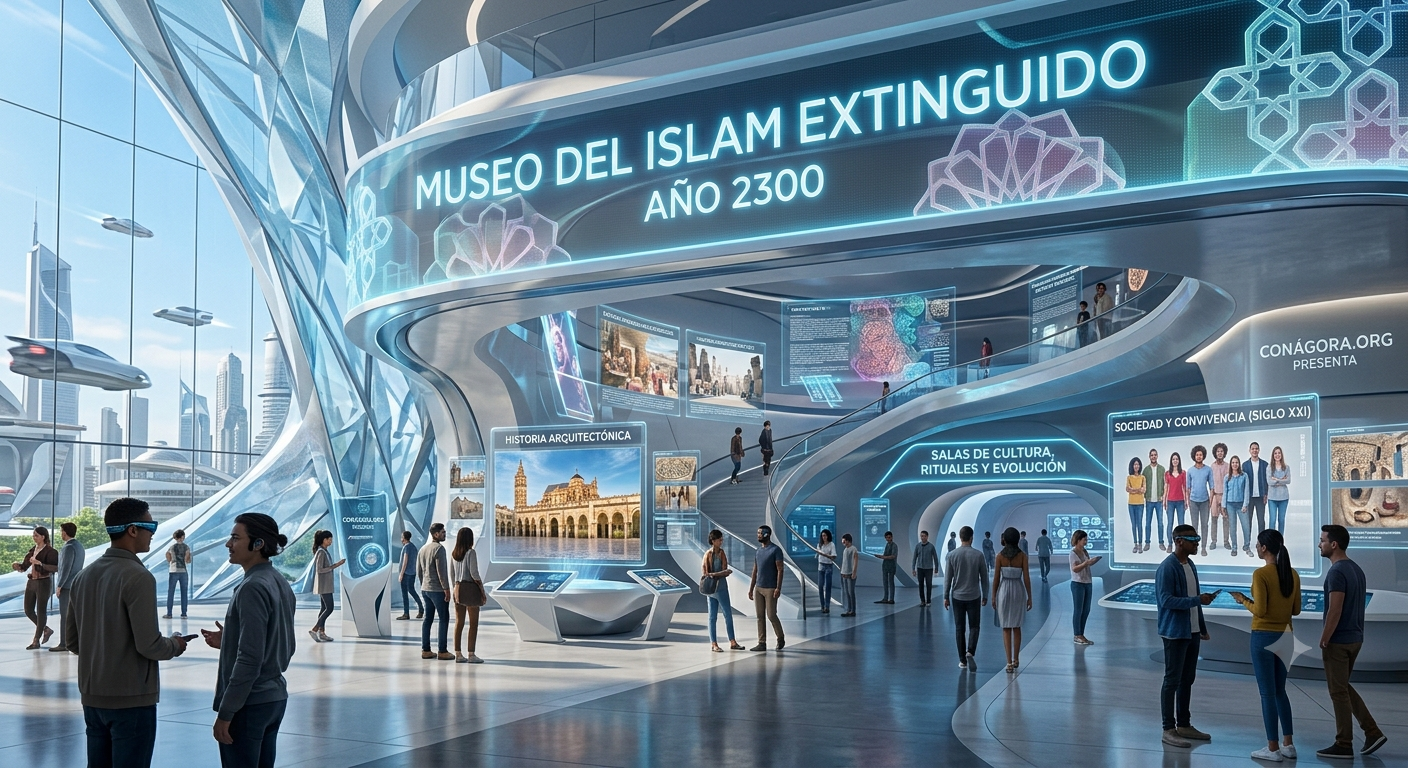
Museum of Extinct and Transformed Religions
The year is 2300. Earth is a strange place.
Cars fly. People spend their weekends in orbital hotels, dogs have automatic translators, and artificial intelligences are still trying to understand why human beings used to argue so much on the Internet.
I find myself in the city of New Barcelona, a floating megacity located where the Mediterranean Sea used to be.
I have come to visit one of the most popular museums on the planet. Its name is: Museum of Extinct and Transformed Religions.
The queue to get in is enormous. Apparently, guided tours of the Islam section are especially popular among teenagers.
Guided Tour of the “Museum of Extinct Islam”
A holographic guide welcomes us at the entrance.
Welcome. Today we will explore some of the religions that shaped human history. Please remember that touching the original objects has been prohibited since the Martian tourist incident of 2287.
The group moves forward. Beside me, a boy of about ten asks his mother:
—Mom, is it true that people used to pray five times a day?
—Yes, darling.
—Without virtual assistants?
—Yes.
—How outrageous.
Room 1: The 7th Century
We enter the first room.
An enormous recreation of 7th-century Arabia appears before us.
The guide explains: “Islam emerged in the year 610 and eventually had more than 2 billion followers.”
The visitors watch in fascination.
—So they didn’t have the Internet? —a girl asks.
—No.
—And how did they argue?
—Mainly face-to-face and sword-to-sword.
The group observes a respectful minute of silence.
Room 2: Ancient Objects
The second room contains valuable relics.
-
An alarm clock programmed for the dawn prayer.
-
A compass for finding the direction of Mecca.
-
A copy of the Quran.
-
A mobile phone with a prayer timetable app.
-
A prayer rug.
-
An illuminated display case containing a jar of gummy sweets, a can of pâté, and a bottle of shampoo. Beside it, a holographic sign explains the concept of Halal and Haram.
The guide: “Incredible but true, citizens of the future. In the 21st century, millions of humans believed that the Creator of the Universe, with billions of galaxies under His command, would become seriously angry if a human consumed a single molecule of gelatin extracted from an animal called a pig. They spent hours in supermarkets reading tiny print so as not to offend the divine.”
The “Fear of Female Hair” Display Case
Different types of fabric (hijab, burqa, niqab) float in the air.
The guide: “For centuries, people believed that the hair of human females emitted invisible radiation capable of completely destabilizing the brains of males, making it necessary to cover them up for ‘public safety.’ The most curious thing is that, instead of training males to exercise self-control, the 21st-century solution was to wrap females in fabric.”
The “Sacred Megaphone” Simulator (Immersive 4D Experience)
A soundproof booth where visitors enter to experience the “ideological noise pollution” of the 21st century.
The guide: “Here you can experience what they called the Adhan. It involved installing giant metal loudspeakers on the façades of places of worship to wake up an entire neighborhood at 5:00 AM by chanting theological doctrines in a language most residents did not understand. If you played electronic music at that volume, you would be fined. But if it was sacred music, it was a constitutional right.”
Room 3: The Great European Debate
This is the most crowded room. A question that obsessed Europe for decades appears on a giant screen:
“Can a religion born more than a thousand years ago adapt to a modern society?”
Below it are thousands of historical headlines:
-
“Does a European Islam exist?”
-
“Is religion compatible with artificial intelligence?”
-
“Can a woman be an imam?”
-
“What will Islam look like in 2100?”
The guide smiles. “Historians consider this one of the longest conversations in human history. It lasted approximately two hundred…”
Room 4: How Did the Great Transition Happen? (A Gentle Death)
This room explains how extinction came about.
There was no violence. Simply, as education became global, women took control of their lives, and artificial intelligence solved the great mysteries of everyday life, the need for a “police God” to monitor what you did in the bathroom or the kitchen gradually disappeared.
The system’s final collapse occurred when technology advanced so far that the instruction manual from the 7th-century desert became completely frozen in time. Religious leaders spent their days trying to adapt camel-era laws to the age of space colonization. Eventually, young people grew tired of waiting for the software to update and simply deleted the app.
Conclusion
The “Museum of Extinct Islam” is not a prophecy of hatred, but a logical warning. Religions do not die because they are persecuted (in fact, persecution often makes them stronger); they die from ridicule and irrelevance when they refuse to walk hand in hand with human progress.
If today’s believers do not want their great-great-grandchildren to view their practices the way we now view medieval superstitions, they had better start opening the windows of their places of worship.
Because the future waits for no one, and in the year 2300, the museum’s virtual reality headsets will be waiting to remind us just how stubborn we were.