
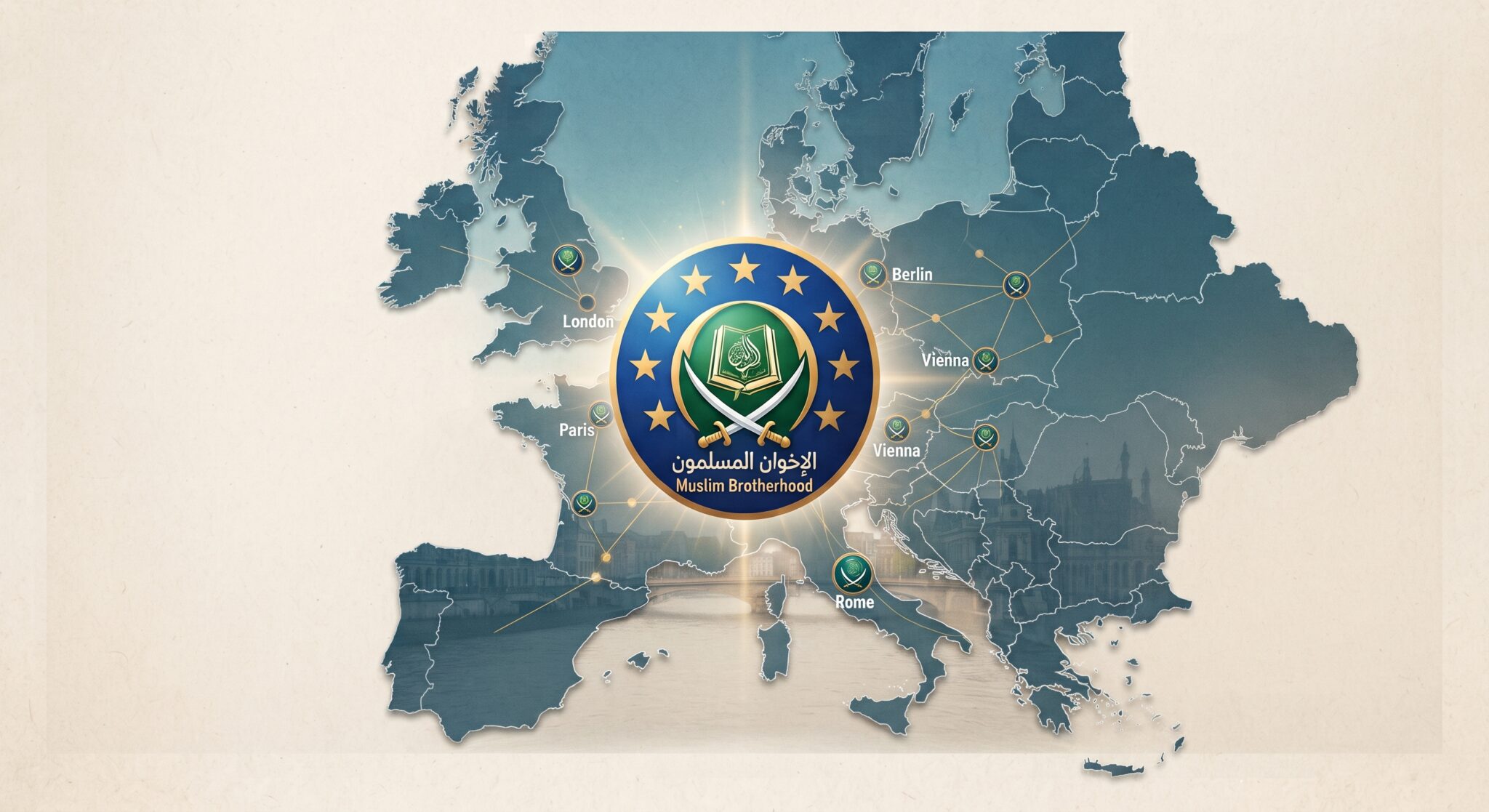
The Art of Wearing a Suit and Tie to Change Laws from Within
Who they are, how they arrived, how they grew, and what future they may have
Some political movements come to power by winning elections; others try to do so by taking up arms.
And there is a third model, much more discreet: building a network of associations, mosques, youth organisations, educational institutions, social organisations and spaces of influence over several decades, until becoming an indispensable interlocutor.
The Muslim Brotherhood belongs to this last category. And that is precisely why it is difficult to understand. It is not simply a terrorist organisation, nor is it simply a religious association. Reducing it to “a conspiracy that controls Europe” does not help us understand reality either.
It is an Islamist movement founded in Egypt in 1928 that has developed various organisations and networks in Europe over the decades. Its European history has been shaped by adaptation, institution-building, social and political activism, and a long-term strategy.
The important question for Europe is not just: How many Muslim Brotherhood members are there?
The question is much more interesting: How much influence do the ideas and networks associated with the movement have?
And there is another question: How far can a liberal democracy go in cooperating with organisations that accept the democratic process but maintain a vision of society deeply shaped by Islamism? That is the real debate.
1. Let’s start at the beginning: Who are the Muslim Brotherhood?
The Muslim Brotherhood, or al-Ikhwan al-Muslimun, was founded in Egypt in 1928 by Hassan al-Banna. Its basic idea was revolutionary for its time: Islam should not be confined to the private sphere.
According to the founders’ vision, Islam should also influence education, society, politics, the economy and the law.
Put simply, they did not merely want Muslims who prayed five times a day. They wanted a society organised according to Islamic principles.
This is what distinguishes Islamism from simple religious conservatism. A conservative Muslim may wish to practise a strict religion. An Islamist also believes that Islam should have a political and social role.
The movement’s own history is linked to the idea of establishing political systems based on Islamic law.
2. Are they a single organisation?
When we talk about the “Muslim Brotherhood” in Europe, we might imagine a perfectly structured organisation, with a central office, a leader and thousands of members. The reality is quite different.
The movement has developed networks and associated organisations, some of which maintain historical, ideological or personal links with the Brotherhood, while others deny being part of it.
That is why it is important to distinguish between the Muslim Brotherhood as a historical organisation and European networks inspired by, linked to, or identified by researchers and intelligence services as belonging to the Brotherhood’s wider sphere.
Not all organisations described as “close to the Brotherhood” acknowledge that relationship. This is one of the main difficulties in measuring its true scale.
An Oxford report specifically devoted to the Muslim Brotherhood in Europe examined its presence in Spain, France, Germany, the Netherlands, the United Kingdom and Scandinavia. It also analyses the different strategies used to adapt to European societies.
3. An ideology different from Salafism
Salafism and the Muslim Brotherhood are not the same thing. Salafists place great emphasis on reproducing the religious practices of the earliest generations of Muslims. The Muslim Brotherhood belongs to the sphere of political Islamism.
Its fundamental concern is for Islam to have a profound influence on how society is organised. Historically, it has also shown a greater willingness to participate in politics, create associations, work with institutions, organise youth movements, establish social organisations, participate in elections, develop educational structures and negotiate with governments.
This organisational capacity is precisely one of its greatest strengths.
4. The key difference: Slow revolution
The Muslim Brotherhood has not followed a single method. Its history is full of changes. In some countries, it has participated in elections. In others, it has faced persecution. Elsewhere, it has developed social associations.
And in Europe, it has learnt a fundamental lesson: you do not need to control the state to influence a society. You can build institutions, create associations, educate young people, train leaders and represent a community before the authorities. You can also get certain people to believe that you are the ones who speak on behalf of Muslims. This last point is particularly important.
5. How did they arrive in Europe?
Their arrival began mainly after the Second World War.
Many activists and supporters left Arab countries where the Muslim Brotherhood was facing persecution. The repression in Egypt was particularly significant. Muslim students and professionals also arrived and began organising associations.
During the 1950s and 1960s, small circles linked to people from Arab countries emerged. New generations followed, and during the 1970s and 1980s these communities began creating permanent organisations.
According to historical research by Pew, during the 1980s many migrants linked to the movement realised that they would not be returning to their countries of origin any time soon and began establishing permanent organisations in Europe. Later generations also adapted part of the agenda to Muslims born and raised in Europe, fundamentally changing the nature of the phenomenon.
6. From exiles to Europeans
The first generation might have thought: “We are in Europe temporarily.”
The second generation began to think: “Europe is our home.”
And the third: “Why should we have to choose between being European and being Muslim?”
The Muslim Brotherhood and its associated networks had to adapt to this new reality. They could not use exactly the same rhetoric they had used in Egypt.
They needed to talk about citizenship, rights, discrimination, identity, education, political participation and integration. A much more European version of the movement emerged, turning Europe into its new battleground.
7. The strategy of the organisations
This is probably where we find the most important characteristic.
The movement does not depend exclusively on a single organisation. It can operate through an ecosystem.
For example:
A youth organisation trains young people.
A cultural association organises activities.
An educational organisation works with families and students.
A religious organisation connects with mosques.
An NGO works on social issues.
A political organisation advocates for certain positions.
A European structure connects organisations across different countries.
The result is a network. And a network can survive even when an organisation disappears.
8. The creation of a European structure
One important milestone was the creation of the Federation of Islamic Organisations in Europe (FIOE) in 1989.
The organisation later explained that its creation marked the culmination of decades of Islamic activity, with roots stretching back to associations established by Muslim students and workers from the 1950s onwards. In 2020, it changed its name to the Council of European Muslims (CEM).
Here, something interesting emerges: Madrid played a historical role. According to FIOE/CEM’s own historical account, a meeting held in Madrid in 1984 helped promote the institutionalisation of European Islamic activity, five years before FIOE was formally established.
In other words, Spain was not a bystander in the European history of the Muslim Brotherhood. It played a role in it.
9. Why was Europe so attractive?
Because Europe offered something that many Arab regimes did not: freedom of association.
In Europe, they could create organisations, publish books, organise conferences, build mosques, establish associations and youth organisations, participate in elections, file complaints, go to court, speak to governments and use the media.
And here we encounter a paradox. European freedoms can also be used by movements that do not necessarily share European values. That does not mean these freedoms should be abolished. It means we need to understand how they work.
10. The Muslim Brotherhood’s politics
Its relationship with democracy is one of the most hotly debated aspects.
The Muslim Brotherhood has participated in electoral systems and used democratic mechanisms.
But the question is not simply: “Do they participate in elections?”
The really important question is: What is their conception of democracy?
There are two very different ways of understanding democracy.
Democracy as a procedure: “We elect the government through elections.”
Liberal democracy: “We elect the government, but there are also fundamental rights that protect minorities, religious freedom, freedom of expression, legal equality and the separation of institutions.”
The second is much more demanding. And that is where the European debate begins.
11. The big question: Political Islam or liberal democracy?
Critics of the Muslim Brotherhood argue that the movement accepts democracy primarily as a means of gaining power and influence, while maintaining a political vision in which religion should occupy a position above that permitted by the European liberal model.
Supporters of the movement would respond that it is a legitimate religious political current and that its participation in democratic processes demonstrates precisely that it does not seek to impose its power through violence.
The reality may be more complicated. An organisation can reject terrorism, participate in elections and formally comply with the law while also seeking to transform society progressively according to a particular religious vision of Islam. That is not necessarily illegal. But it can become a political problem in Europe.
12. The strategy of “small steps”
Here we encounter one of the most frequent criticisms.
According to its detractors, the aim would not be an immediate revolution.
It would be gradual transformation: family → education → community → associations → politics → institutions.
The strategy would be to build a social base first. Not to seize power tomorrow, but to lay the foundations for gaining influence over the next ten, twenty or thirty years.
13. The power to represent “Muslims”
Here we encounter one of the most interesting problems. Europe needs Muslim interlocutors. Governments want to speak to representatives of Muslim communities.
Local councils need to negotiate issues relating to mosques, cemeteries, religious education, food, religious festivals, integration and the prevention of radicalisation.
And this raises a question: Who really represents Muslims? An association may have a perfectly organised structure, but that does not mean it represents all Muslims.
Nevertheless, a well-organised organisation can end up speaking on behalf of a community far larger than its own membership.
14. And that is one of the keys to power
You do not need millions of members to have influence. You need to become the organisation people call when they want to speak to Muslims.
This is far more important than the number of members. And it is one of the reasons why there is currently a European debate about networks linked to the Muslim Brotherhood.
15. The French case: The debate has erupted
In 2025, the French government published a report on the Muslim Brotherhood and political Islamism in France.
The document sparked enormous controversy because it argues that there is a long-term strategy of influence and warns of networks operating across different sectors of society.
The French debate quickly took on a European dimension. Questions were raised in the European Parliament about the report’s conclusions and the possible influence of networks linked to the Muslim Brotherhood within European institutions.
16. And what is Europe’s official position?
Here we find a very interesting detail.
In 2025, questions were raised in the European Parliament about the influence of the Muslim Brotherhood. The European Commission was asked about the scope and structure of its activities and about possible measures to counter extremist influence.
But this is important: a parliamentary question is not the same as an official conclusion by the Commission. It is part of a political debate.
The European Commission is currently examining, more broadly, issues relating to transnational networks, foreign funding, radicalisation and external influence.
In its 2025 report on geopolitical factors and external influences, the Commission specifically highlights the need to examine transnational networks, foreign funding and influence over diaspora communities within a rights-based framework.
17. Are the Muslim Brotherhood terrorists?
This question comes up constantly. And the answer requires precision. It is not accurate simply to say that “the Muslim Brotherhood are terrorists”.
Jihadist terrorist organisations are not identical to the Muslim Brotherhood movement. Al-Qaeda and Islamic State represent a different and much more radical current that uses terrorist violence.
Indeed, one of the major challenges in analysing the subject is precisely to distinguish political Islamism from violent jihadism.
If we mix these two concepts together, we stop understanding how each one works.
18. But we must not fall into the opposite extreme either
Saying that the Muslim Brotherhood is not equivalent to Al-Qaeda does not mean that its ideology is necessarily compatible with European values.
That is a separate debate. An organisation can reject terrorism while defending a different vision of society.
It can accept elections while seeking to increase the influence of religion over legislation.
It can defend the rights of Muslims while maintaining positions that are difficult to reconcile with certain individual rights.
There are conflicts over issues as important as equality between men and women, LGBT rights, freedom of conscience and European identity.
19. The Muslim Brotherhood in Spain
And here we come to a particularly interesting chapter.
Spain’s history has its own distinctive characteristics. The Muslim Brotherhood’s presence in Spain was historically closely linked to the Syrian branch of the movement.
During the 1960s, members of the Syrian Muslim Brotherhood arrived in Spain, fleeing persecution by Hafez al-Assad’s regime. Oxford’s academic research on the movement in Spain explains that this presence was initially closely linked to cultural organisations and the publication of Islamic ideas, and that the organisation subsequently lost strength as a distinct structure during the 1990s.
This is important because it means that Spain’s history is not simply a copy of Egypt’s.
20. Spain as a meeting point for Europe
Spain also played a particular role in the development of European Islamic networks.
As we have seen, Madrid hosted a meeting in 1984 that FIOE later described as an important step towards the institutionalisation of the European Islamic movement.
FIOE was formally established in 1989. This structure later became the Council of European Muslims.
Therefore, Spain did not merely receive Islamist networks. It also participated in the historical development of some of Europe’s Islamic organisational structures.
21. Is there currently a “Muslim Brotherhood organisation” in Spain?
We need to be very cautious here.
It would not be accurate to claim that there is a single, clearly identifiable Spanish organisation, publicly recognised as “the Muslim Brotherhood of Spain”, that controls Spain’s Muslim movement. The reality is much more fragmented.
There are Islamic associations, cultural organisations, educational structures, federations and individuals whom various researchers or security services have historically linked to the Muslim Brotherhood’s wider sphere.
22. The real future of the Muslim Brotherhood in Spain
Here we can imagine several scenarios.
Scenario 1: Organisational decline
The old Muslim Brotherhood structure continues to lose its distinct identity. Its former networks become integrated into broader Muslim associations. The name “Muslim Brotherhood” loses importance.
Scenario 2: Transformation
The organisations gradually abandon the Brotherhood’s historical identity and become European Muslim movements. They retain some of its thinking but adapt their language. This scenario could be highly significant.
Scenario 3: A new generation
Young people born in Spain may create a new European Islamism. It would no longer be exactly Egyptian, Syrian or Moroccan. It would be Spanish. Such a movement could be much more difficult to identify.
23. The great challenge: The “domestication” of Islamism
Here we encounter a fascinating possibility.
Europe may end up producing something that never existed in the countries of origin: a European Islamism.
A movement that maintains Islamic identity, community solidarity and social organisation,
but accepts democracy, elections and European citizenship.
Would it still be Islamism? Probably.
Would it be compatible with liberal democracy? Probably not.
24. Europe needs to understand these networks, not demonise them
“The Muslim Brotherhood controls Europe.” No.
“They pose no problems at all.” Neither is that accurate.
The most sensible position is: “Let’s examine who they are, what organisations they have, who funds them, what ideas they defend, whom they collaborate with and how much influence they actually have.”
25. The question of money
An organisation may have very good ideas. But if we want to understand its influence, we also need to follow the money.
Who funds the associations? Who buys the buildings? Where do the donations come from? Is there foreign funding? Is there transparency?
The European Commission itself is paying greater attention to foreign funding and transnational influences as factors that may affect European cohesion and security.
26. We must also follow soft power
Power is not always about money. It is also about ideas, contacts, prestige, the ability to mobilise people, access to politicians and universities, the ability to organise demonstrations, the ability to speak on behalf of a community and the ability to influence the media.
That is the real soft power. And this is where the Muslim Brotherhood and its associated networks may be particularly interesting to researchers.
Conclusion: Real power does not always wear a uniform
The Muslim Brotherhood is not an army. It does not need tanks. It does not necessarily need to carry out attacks. Its historical strength has been something else: organisation.
For decades, it has demonstrated an enormous capacity to build associations, train activists, create institutions and develop transnational networks. That is precisely why Europe should study it.
What do they want to change? How do they want to change it? With what money? Through which organisations? Whom do they really represent? What relationships do they have with other networks?
And above all: Do they accept that in Europe the law is the same for everyone, that individuals have freedom of conscience, and that no religion stands above fundamental rights?
If the answer is yes, we are dealing with a religious and political current that can be debated and criticised within a democracy. If the answer is no, Europe has a problem.
And here we arrive at one of the major questions Europe should continue investigating over the coming years: Are we witnessing the birth of a European political Islam?
Because perhaps the future of the Muslim Brotherhood in Europe will not be about the Muslim Brotherhood growing. Perhaps it will be about something much more interesting: its ideas surviving even if its name disappears.