
Who Pays for the Party (and the Mosque)? The Complex Issue of Islamic Funding in Europe
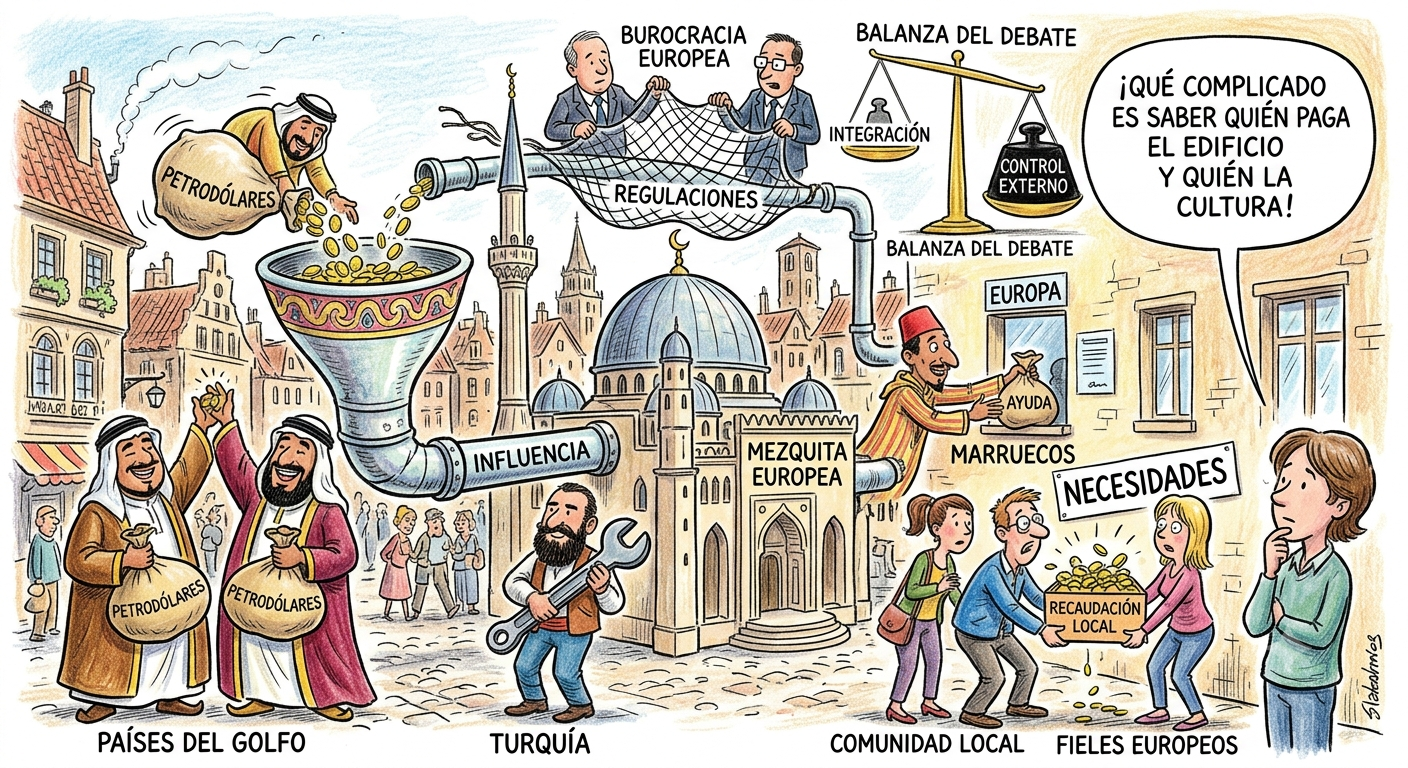
Surely, at some point, you have wondered: when a mosque is built in the centre of a European city or in a Spanish village, where does the money come from? Do worshippers pass around a collection box after Friday prayers, or is there someone in an office thousands of kilometres away signing cheques with lots of zeros?
The short answer is: a bit of both, but the second source can carry considerable weight. The longer answer takes us into a diplomatic soap opera involving petrodollars, geopolitics, cultural tensions and a Europe that has spent decades trying to work out how to manage its own diversity without unpleasant surprises.
Because behind an apparently boring issue — funding — lies one of the most important debates about the future of Islam in Europe.
Money Is Never Neutral
There is a fairly simple rule in politics, religion and business: whoever provides the money usually wants to influence something. Not always in a negative way, but people rarely hand over large sums without expecting anything in return. That is why the question is not simply who pays for mosques. The question is: what influence comes with that money?
The Four Main Sources of Funding
1. Worshippers
This is the simplest and most transparent model. Believers make voluntary donations, the community raises funds, and a building is purchased or a mosque is constructed. It is similar to the model used by many churches, associations and religious communities across Europe.
Its main advantage is obvious: the community controls its own destiny.
Its main drawback is equally obvious: many small communities lack the financial resources to fund major projects.
2. Foreign Governments
This is where the controversy begins. For decades, some governments in Muslim-majority countries have funded mosques, cultural centres, imams and religious activities in Europe.
The names that often appear in the debate include Saudi Arabia, Turkey, Morocco, Qatar and other Gulf countries.
Not all such assistance is problematic. But many experts ask whether ideological influence can accompany this money.
The concern is not merely economic; it is also cultural and political.
3. International Foundations and Organisations
Private organisations exist that fund religious projects in different countries. Sometimes, they promote entirely legitimate cultural activities.
On other occasions, they have been accused of spreading highly conservative interpretations of Islam. The problem for European citizens is that it is often difficult to establish exactly who funds what.
4. Their Own Economic Activities
Some mosques generate income through courses, cultural activities, publications, events and the rental of premises.
This model reduces external dependence, although it is usually insufficient to fund major projects.
Why Is This an Issue of Concern in Europe?
Because mosques are not merely buildings; they are also places where values, ideas and worldviews are transmitted.
The vast majority of European mosques fulfil ordinary religious functions and contribute to community life. However, when external funding lacks transparency, a legitimate question arises:
Are foreign conflicts, ideologies or interests also being imported?
Europe does not just import money; sometimes it imports influence as well.
The Debate over the “Sponsored Imam”
Imagine two situations.
Case A: The imam was born in Europe, speaks the local language fluently, understands the country’s culture, and relies on the local community for his income.
Case B: The imam is sent from another country, his salary depends on a foreign institution, and he received his training outside Europe.
There may be significant differences in how each interprets the world around them. Many European governments believe this issue will become increasingly important over the coming decades.
The Problem of Transparency
This is probably where the real heart of the debate lies. It is not just about who provides the funding; it is about knowing who does so. In a modern democracy, transparency builds trust.
When funding sources are clear, suspicions decrease, conspiracy theories become less widespread, public trust improves and social cohesion is strengthened.
When funding is opaque, the opposite happens.
The Two Competing Narratives
Narrative 1: “There Is No Problem”
Those who defend this position argue that religious freedom includes the right to seek funding, many religions receive international assistance, Muslim communities should not automatically be viewed with suspicion, and most mosques do not pose any risk.
Narrative 2: “There Must Be Oversight”
Those who defend this position argue that some countries use religion as an instrument of influence, Europe should know who funds religious institutions, opacity facilitates radicalisation, and transparency protects both citizens and Muslim communities themselves.
Both positions contain reasonable arguments. The challenge is to strike a balance.
The Futuristic Scenario: The Mosque with a Nutrition Label
Imagine an idea for 2035.
Every European mosque would have a public information sheet accessible online, something similar to food labelling.
It would show the origin of its funding, the percentage of domestic funds, the percentage of foreign funds, the training received by its imams, the activities it carries out and the audits it undergoes.
It would be a kind of “transparency label”, not designed to control beliefs, but to make clear how an institution that forms part of public life operates.
What Problems Does This Pose for Europe?
External dependence: When an institution depends financially on foreign actors, it may lose some of its autonomy.
Lack of public trust: Opacity fuels rumours and polarisation.
The risk of importing conflicts: Political or religious rivalries from other countries can spill over into European territory.
The difficulty of developing a European Islam: If much of the funding, training and leadership comes from abroad, developing an interpretation adapted to European realities becomes more difficult.
Possible Solutions
Cutting off the external funding tap (the Austrian model): Countries such as Austria, with its well-known Islam Law, and France have introduced reforms aimed at restricting or prohibiting ongoing foreign funding of religious organisations.
Creating public funding registers: Transparency should be the norm for all religious organisations.
Training imams in Europe: Their training should include knowledge of European laws, languages and democratic values.
Encouraging local self-financing: The stronger the local community, the lower its dependence on external funding.
Independent audits: Similar to those carried out by many foundations and non-profit organisations.
European transparency certification: A voluntary label identifying mosques that meet high standards of financial transparency and governance.
Conclusion: Follow the Money
In detective films, there is a classic rule: “Follow the money.”
Not because money is bad, but because it helps us understand how institutions really work.
Asking who funds a mosque should not be considered an attack. It should be regarded as a normal question in any mature democracy. The issue is not whether a mosque receives money. All organisations need resources.
The question is whether citizens know where that money comes from, what influence may accompany it, and how to ensure that religious freedom coexists with transparency and social cohesion.
Because when trust disappears, rumours take its place, and rumours rarely build a better society.
Freedom of worship is a cornerstone of Europe. However, allowing foreign states to shape the continent’s religious and cultural landscape by writing large cheques has proved to be a poor long-term strategy. The solution is not to close the doors, but to demand transparency, full accountability and local training so that European Islam can be, precisely, European.