
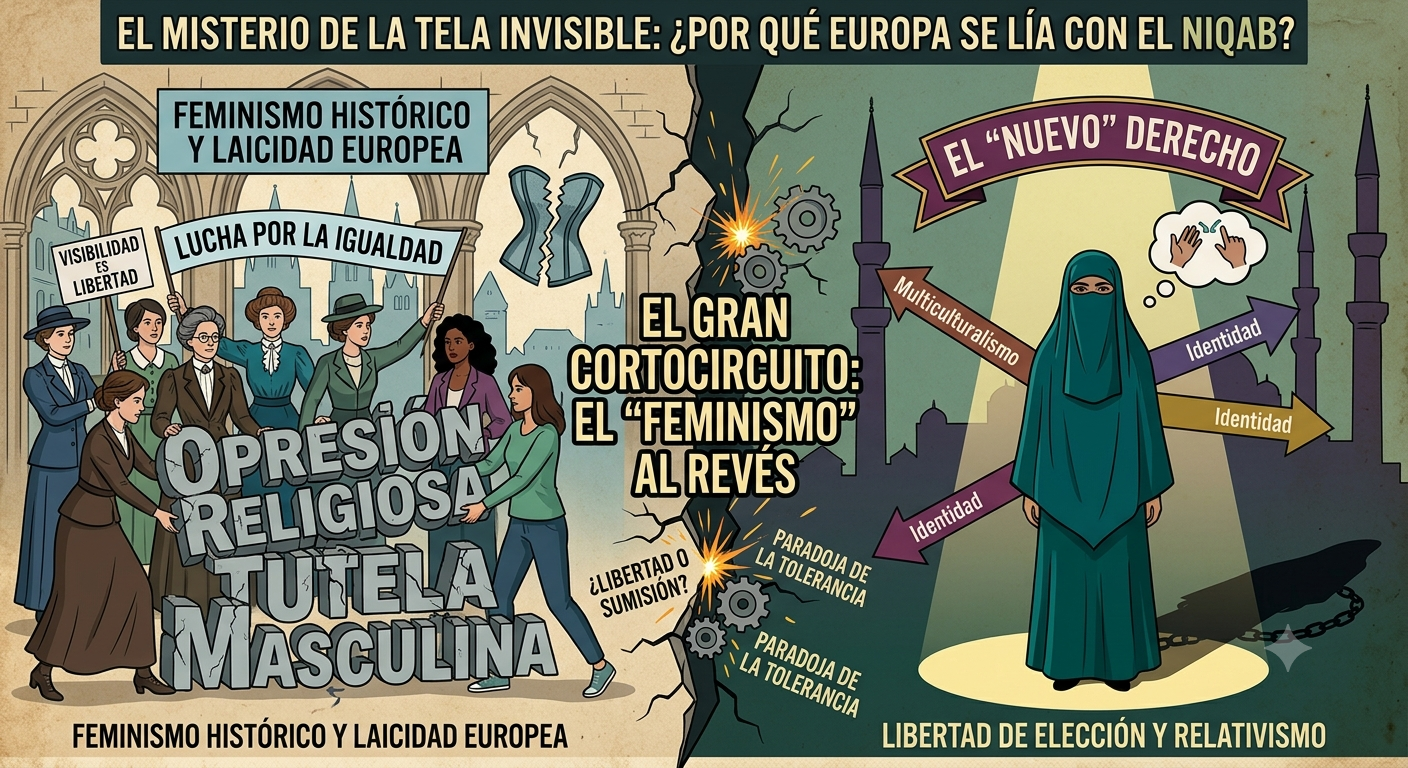
The Mystery of the Invisible Fabric
Imagine deciding to go to the bank, attend a job interview, or renew your driving licence while wearing a helmet. Or better yet, a Batman mask. Most likely, aside from getting a few strange looks, a security guard would politely—or not so politely—ask you to show your face.
In Europe, we have a very simple unwritten rule: to live together, we look each other in the eyes. Yet one piece of fabric has managed to turn European courts, parliaments, and cafés upside down: the niqab.
For the average European citizen, seeing someone wearing a niqab is like seeing an astronaut in a supermarket: it causes a mental short circuit. The debate over the niqab has never been solely about clothing. It is a debate about freedom, equality, identity, religion, and the kind of society Europeans want to build.
As so often happens in Europe, nobody entirely agrees.
How can a piece of black fabric cause such a mental short circuit on the continent of freedom? Let’s dissect this dilemma with logic, a little irony, and no beating around the bush.
First, Let’s Set the Record Straight
There is a great deal of confusion.
Hijab: Covers the hair.
Niqab: Covers the face, leaving the eyes visible.
Burqa: Covers the entire body and face.
The Great Short Circuit: “Feminism” Turned Upside Down
One of the most fascinating—and, for many, frustrating—aspects of this debate in Europe is watching certain political groups and left-wing or liberal opinion circles defend the wearing of the niqab in the name of “human rights” and “freedom of choice.”
Let’s pause for a moment to process that.
Europe, the birthplace of feminism, where women have fought for centuries to free themselves from corsets, male guardianship, and religious oppression, suddenly finds itself confronted with intellectuals saying: “Look, if a woman voluntarily chooses to cover her entire face when going out in public, we must respect that because it is her individual freedom.”
This is where European logic starts smoking. Is it really “freedom” to choose a garment whose origins and symbolic meaning are associated with making women invisible in public life?
Criticizing the niqab is not Islamophobia; it is simply democratic common sense. Defending the niqab as “just a fashion choice” or a “right to identity” is like saying that chains are a fine piece of costume jewellery.
Europe’s real problem with the niqab is the paradox of tolerance: if you tolerate the intolerant, the intolerant will destroy you.
The Experiment
Imagine that tomorrow a new religion appears. Its followers believe that men must completely cover their faces in public.
Question: How long would it take Europe to launch a national debate?
My guess is about two and a half hours, and that brings us to an important question.
Are we defending a universal principle, or are we reacting to a specific practice?
The Collision: Freedom of Religion vs. Human Dignity
The real conflict on European soil is not religious. It is a direct clash between two fundamental principles:
– Side A (Absolute Individual Freedom): “Everyone can dress as they wish. If the state starts meddling in people’s wardrobes, we become a dictatorship. Banning it is discriminatory and will isolate these women even further in their homes.”
– Side B (Dignity and Public Safety): “The face is the ID card of human interaction. Concealing it undermines women’s dignity and breaks the social contract. Besides, in a modern society, we need to know who is walking beside us for basic security reasons.”
The underlying problem is that the niqab is not an issue affecting Islam as a whole. The vast majority of Muslim women in Europe do not wear it or consider it obligatory. The niqab is an export of an ultra-conservative movement—Salafism/Wahhabism—that exploits the gaps in Europe’s system of freedoms to promote an agenda that ultimately despises those very freedoms.
This is the paradox of tolerance: should we tolerate cultural expressions that promote intolerance or inequality?
What Is the Solution? Fewer Inhibitions, More Firmness
Europe has spent years struggling with a postcolonial guilt complex that leaves it paralysed. For fear of appearing racist or intolerant, it often prefers to look the other way. But the solution is not that complicated if we set those inhibitions aside.
Firmness in public spaces: Countries such as France, Belgium, and Denmark have already taken the step of banning face coverings in public spaces. The aim is not to ban religious symbols—you can wear a hijab or a giant cross if you wish—but to prohibit covering the face.
If you cannot enter the metro wearing a balaclava, you should not be able to do so wearing a niqab either. The rules of coexistence apply to everyone.
Real support for women, not for fabrics: Genuine integration does not mean endorsing women’s isolation. It means giving women the economic, educational, and social tools they need to avoid depending on suffocating family or community structures. If a woman depends on wearing the niqab to be accepted by those around her, we are not looking at “free choice” but at subtle coercion.
Clear red lines: Europe must decide which values are negotiable and which are not. Equality between men and women and transparency in social interaction are pillars of our democratic architecture. If we allow them to crumble in the name of a misunderstood form of multiculturalism, we will end up building a society of ghettos in which women will be the first to lose out.
Conclusion
The niqab is not a bridge between cultures; it is a fabric wall between people. Defending women’s rights in Europe means defending them for all women, regardless of their family’s postcode or their parents’ religion.
It is time for Europe to stop biting its tongue: an uncovered face and an open gaze are not merely European cultural preferences; they are the minimum requirements for treating one another as equals.
The niqab is much more than a garment. It is a mirror, and when Europe looks into that mirror, it discovers its own contradictions.
It wants freedom, but also shared values.
It wants diversity, but also social cohesion.
It wants to protect women, but also respect their choices.
Perhaps that is why the debate never ends.
Because the niqab forces Europe to answer a question it has been avoiding for decades: Is there a limit to freedom in an open society?
And I suspect we will continue arguing about it for many years to come—preferably while looking each other in the face.