
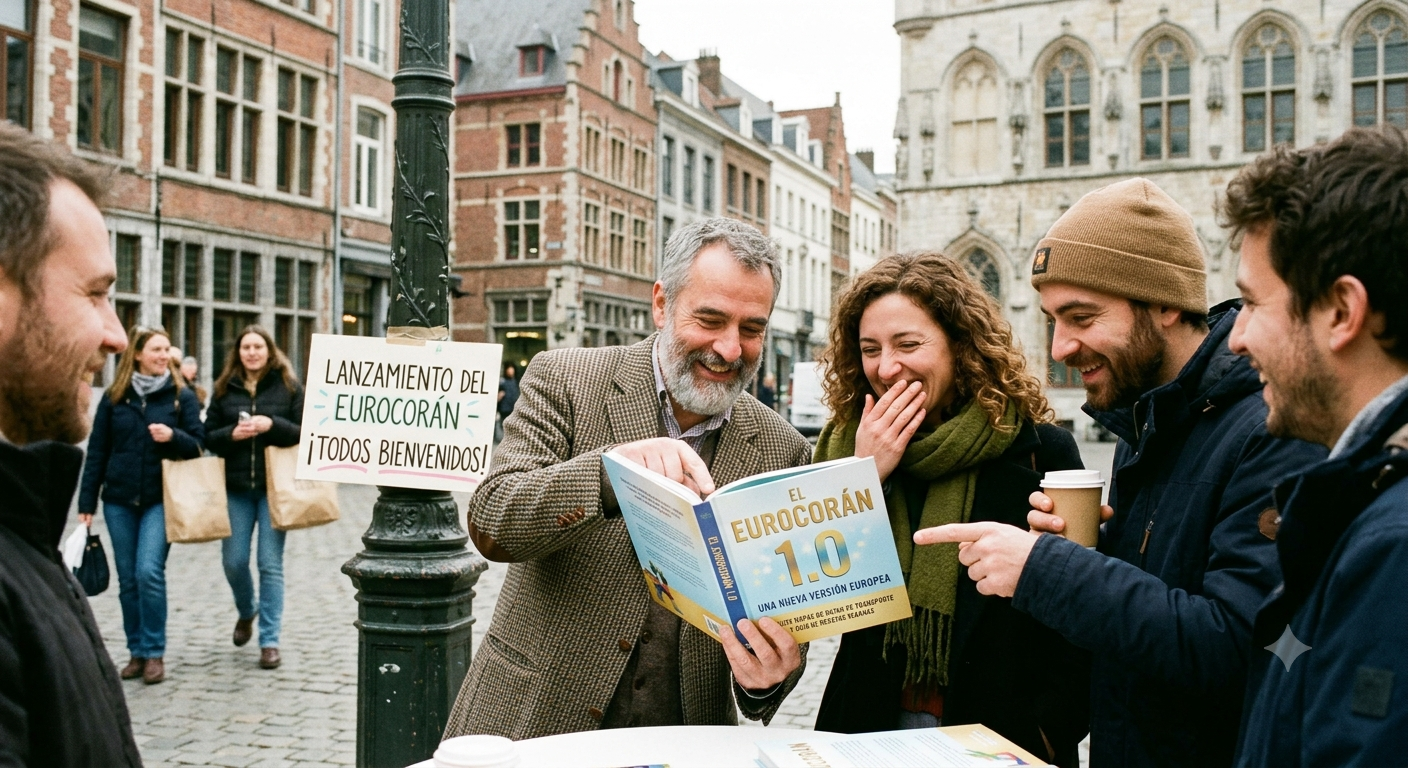
The “EuroQuran 1.0”: What Would the Holy Book Look Like If the European Union Edited It?
This article is an exercise in imagination. It does not propose modifying any religious text, nor does it seek to offend anyone’s beliefs. Its sole purpose is to raise a question: What happens when a religion born 1,400 years ago encounters twenty-first-century Europe?
Imagine a news story published in 2050.
“The European Union officially presents the European Quran 1.0.”
A group of imams, philosophers, human rights lawyers, and a bored European Commission official spend two years meeting in a grey building in Strasbourg. Their mission: to produce an annotated version of the Quran designed to coexist, without friction, with European liberal democracy. With little imagination, they call it the “EuroQuran 1.0.”
The internet explodes. France is debating Chapter 12, Sweden wants to add a preface, Italy asks for more references to gastronomy, and Spain proposes including a warning: “Best read with a cup of coffee.”
For weeks, nobody talks about anything else. But beyond the joke, the question is interesting: Can a message born in the seventh-century desert speak directly to someone living in Barcelona, using artificial intelligence and paying with their mobile phone?
EuroQuran 1.0: A version of the Quran adapted exclusively to the “European lifestyle.”
What would it look like? What would change? How would we adapt the pillars of Islam to the reality of a continent obsessed with bureaucracy, health, and public order?
What Would It Look Like?
The Profession of Faith (Shahada)
Instead of a public declaration, to qualify as a “Euro-believer,” you would have to fill out a one-page online form and tick the box: “I accept that my faith may be processed by the Brussels algorithm for statistical and social cohesion purposes.”
Prayer (Salat), Through an App
The obligation to pray five times a day clashes with European productivity. The EuroQuran would stipulate: “Prayer shall be performed from Monday to Friday, preferably during the coffee break, through the digital platform.” The direction would no longer be towards Mecca, but towards Strasbourg. There would also be standardised protocols for ritual cleansing, including a table showing maximum water savings.
Almsgiving (Zakat), as an Administrative Levy
Voluntary charity is not efficient enough. In the EuroQuran, Zakat would become the “Mandatory Interterritorial Solidarity Levy,” automatically deducted from salaries and managed by a Norwegian sovereign wealth fund.
Fasting (Sawm)
Ramadan is too demanding for the European pace of life. The EuroQuran would rename it “The Month of Intermittent Fasting and Digital Detox,” recommended by nutritionists. There would also be regulations governing Ramadan fasting in relation to the Working Time Directive and energy consumption.
Regulations on Pilgrimage (Umrah and Hajj)
These would address their impact on the carbon footprint and explore virtual pilgrimage alternatives.
Paradise, with an Energy Rating
Descriptions of rivers of milk and honey would be replaced with: “A sustainable residential environment with an A+ energy certificate, high-speed Wi-Fi, and shared green spaces.”
Because Europe loves trends, special editions of the EuroQuran would be available: The Nordic Edition, The Mediterranean Edition…
What Would Change?
The language would probably change.
A European in 2026 understands this more easily: “Respect others.” Rather than: “Act in accordance with the customs of a seventh-century tribe.”
Modern questions are different. Fourteen hundred years ago, people asked: How do we survive the winter? How do we travel across the desert? How do we resolve conflicts between tribes?
Today, we ask: Will artificial intelligence have rights? Why do we work eight hours a day? When will I be able to afford a home? Who invented Zoom meetings?
Societies change, and so do their questions.
The New Values
A hypothetical European edition would probably emphasise five ideas: freedom, equality, democracy, separation of religion and state, and a sense of humour.
Because if there is one thing that characterises Europe, it is its ability to debate absolutely everything. Especially on X.
Conclusions
The uncomfortable question is perhaps not: “Should the Quran have a European version?” Maybe the right question is: “How can ancient ideas coexist with modern societies?”
Because this does not affect Islam alone. Other religions, philosophies, and ideologies have faced the same challenge. Sooner or later, they have all had to answer the same question: “Which parts belong to the past, and which remain useful today?”
The Final Chapter
Imagine the last page of the hypothetical European Quran. It might read something like this:
“Be free. Be responsible. Treat your neighbours well. Distrust those who have all the answers, and never forget to laugh a little at yourselves.”
And underneath, in small print: “Update available in 2070.”
Perhaps that is the most European thing of all: the idea that no society is ever finished, that everything can be debated.