
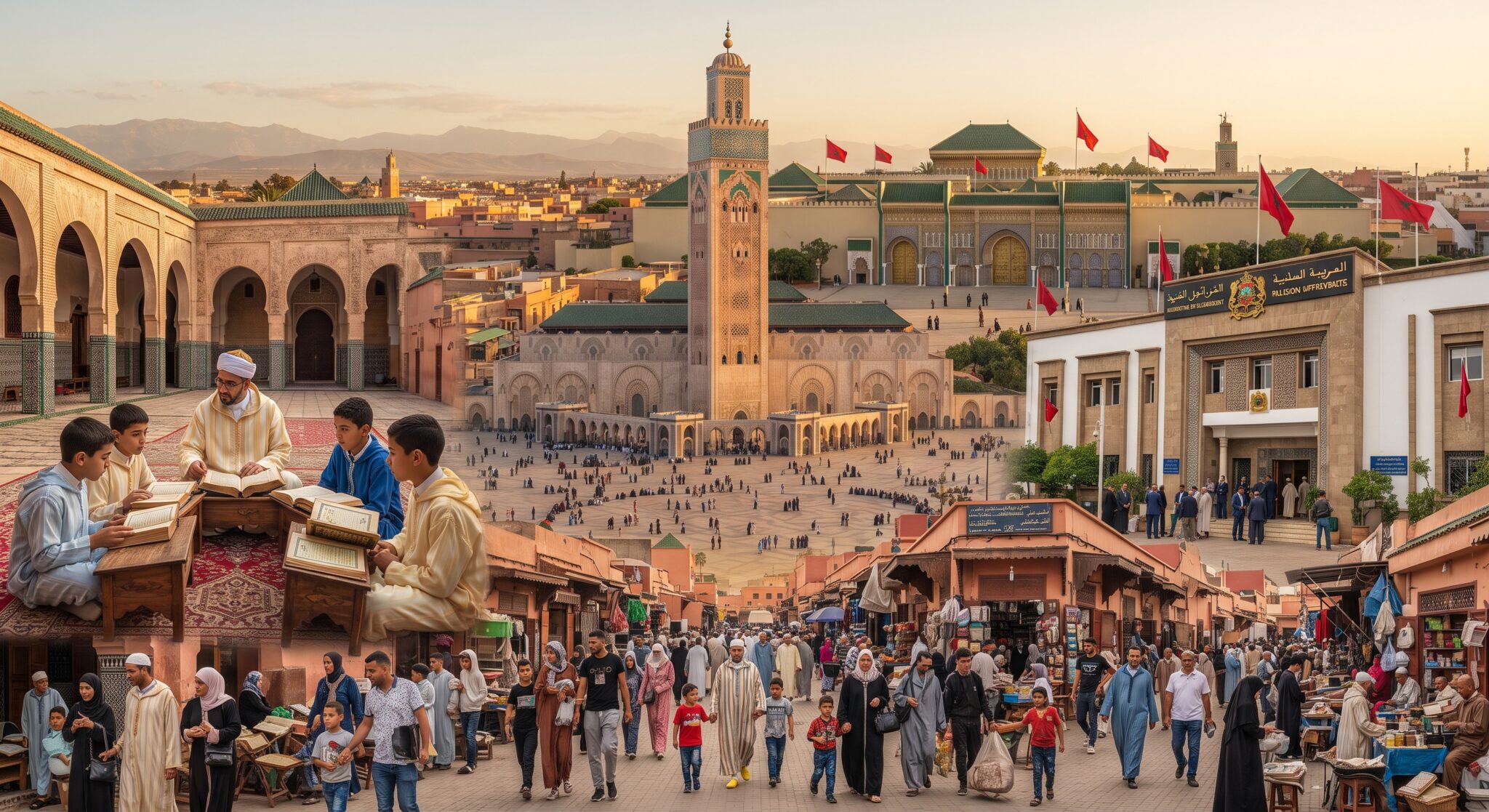
To Understand Islam in Europe, We Must Look at Its Roots
To understand Islam in Europe, we must look beyond Europe’s borders.
The Islam we encounter in Europe today did not originate in Europe. Its ideas, religious currents, institutions, leaders and many of its forms of organisation have their roots in countries where Islam is the majority religion.
Therefore, if we want to understand what kind of Islam is arriving in Europe, where it comes from, who represents it and what influence it may have, we must first understand what is happening in its countries of origin.
There is no single Islam. There are different currents, religious schools, organisations and interpretations. There are also significant differences between countries. Islam in Egypt is not exactly the same as Islam in Algeria, Morocco, Saudi Arabia, Turkey or the Gulf states.
Furthermore, religion does not always operate independently of political power. In many Muslim-majority countries, religious institutions maintain important relationships with the state, governments, the military, business leaders and various social organisations. These relationships can influence how Islam is interpreted and transmitted.
Some of that influence can reach Europe through mosques, associations, religious organisations, funding, educational centres, religious leaders, international networks or immigrant communities.
That is why studying Islam in Europe without also studying its roots can lead to an incomplete picture.
The question is not simply, “What kind of Islam exists in Europe?”
We must also ask: Where does it come from? Who funds it? Who represents it? Which institutions stand behind it? Which religious current does it promote? What relationship does it maintain with the political power of its country of origin? And how does it change when it arrives in Europe?
In this series of articles, we will examine precisely this ecosystem.
Country by country, we will study religious institutions, their main currents, who holds power within them, how they are funded, their relationships with politics, business leaders and other power structures, and the connections that may exist with Europe.
The aim is to understand their roots in order to better understand their presence in Europe. Because to engage properly with any phenomenon, we must first understand how it works, where it comes from and who its main actors are.
In Morocco, Understanding Power Means Understanding Religion
Who controls religion, who funds it, and how the king, religious scholars, politics, business leaders and the military are connected
When we talk about Islam in Morocco, we usually think of mosques, imams, Ramadan, the Quran or religious traditions. But that is only part of the story.
Morocco has something much more complex: an institutional system built around religion.
There is a king with constitutionally recognised religious authority, a Ministry of Endowments and Islamic Affairs, a Supreme Council of Ulema, local councils of ulema, thousands of mosques, imams and preachers, religious property, foundations, schools, training institutes, Islamist movements and a specific religious guidance structure within the armed forces.
Behind all this lies a fundamental question: Who has the power to decide what constitutes official Islam in Morocco?
The short answer is that the monarchy occupies the central position.
But the full answer is much more interesting.
The Moroccan system does not simply work by having the king “give orders to the imams”. It operates through a combination of religious legitimacy, state institutions, administrative control, funding, training, property, politics and security.
That is the real ecosystem of Moroccan Islamic power.
The Central Figure: The King as “Commander of the Faithful”
To understand Morocco, we must begin with a figure that has no exact equivalent in most European countries: Amir al-Mu’minin, usually translated as “Commander of the Faithful”.
Article 41 of Morocco’s 2011 Constitution establishes that the king is the Amir al-Mu’minin, responsible for ensuring respect for Islam and guaranteeing freedom of worship.
But there is something even more important.
The king presides over the Supreme Council of Ulema, the institution responsible for issuing fatwas that may be officially adopted by the state. The Constitution also establishes that the king exercises his religious prerogatives relating to the institution of the Imarat al-Mu’minin through royal decrees known as dahirs.
This changes the entire structure.
In many Muslim-majority countries, we might ask: Who has religious authority? In Morocco, the institutional answer begins with the king.
Not simply because the king is a political ruler who uses religion, but because the constitutional order itself assigns him a specific religious role. This has enormous political consequences.
The King Is More Than the Head of State
The Constitution distinguishes between the king’s functions as head of state and his religious functions.
Article 42 defines the king as head of state, supreme representative, symbol of national unity and guarantor of the continuity of the state.
Article 41, by contrast, establishes his position as Amir al-Mu’minin.
In other words:
KING → political authority
KING → religious authority
This combination is fundamental. It means that questioning certain religious decisions can also have political implications. It also means that movements seeking to establish religious authority independent of the monarchy enter particularly sensitive territory.
The Ministry of Endowments: The Great Administrative Machine
If the king occupies the top of the system, the Ministry of Endowments and Islamic Affairs is one of its main administrative instruments. Its role is extensive.
Legislation assigns the Ministry responsibilities that include managing and developing Habous properties; building and maintaining mosques; supervising religious activities; protecting the Maliki rite; organising traditional religious education; providing initial and ongoing training for religious officials; disseminating official religious doctrine; and coordinating international religious cooperation.
The Ministry is therefore not simply an organisation that “manages mosques”. It is a genuine administrative infrastructure for religion.
It controls or participates in many of the elements that enable organised religion to function physically:
Buildings + property + imams + training + education + religious guidance.
What Are Habous?
Here we encounter a key term for understanding how the system is funded: Habous, equivalent to a waqf, or religious endowment.
These are assets dedicated to religious, social or charitable purposes. In Morocco, they represent a substantial body of property. The Ministry itself explains that Habous assets include urban and agricultural properties.
In 2017, for example, income from urban Habous properties reached approximately 350.2 million dirhams, while net agricultural income for that year exceeded 66.1 million dirhams. The Ministry explicitly states that this property portfolio serves as a source of self-financing for social, religious and administrative activities.
This helps us understand something important: Morocco’s religious ecosystem does not depend exclusively on the general state budget. It also possesses its own income-generating assets.
Therefore, when discussing the financing of Islam in Morocco, we must consider at least four sources:
- Public funding.
- Habous property and assets.
- Donations and resources from religious foundations and organisations.
- Assets and resources associated with particular religious institutions.
Not all the money comes from the same source, and not all organisations operate under the same financial arrangements.
Mosques: Religion, Administration and Public Space
From the outside, a mosque may appear to be simply a place of prayer. For the Moroccan state, however, it is also an institution within the country’s religious organisation.
Among other responsibilities, the Ministry’s Directorate of Mosques handles mosque registration and oversight, identifies the need for places of worship, and plans their construction, expansion and restoration.
The Ministry also publishes a guide for imams, preachers and religious officials.
Its stated purpose is to establish common rules and preserve doctrinal and ritual unity throughout the country. The guide explicitly links the activities of religious officials to the Maliki rite, Ash’ari theology and Moroccan religious tradition.
The system therefore aims to do more than ensure that people have a mosque in which to pray. It also seeks to establish a particular Moroccan way of practising Islam.
The Imam: Much More Than the Person Who Leads Prayer
Within this system, the imam has religious, educational and social responsibilities.
The Ministry states that imams must lead prayers; teach the Quran; contribute to social cohesion; participate in educational and cultural activities; cooperate on certain social issues; respect the established Maliki rite and doctrine; and refer certain religious questions to the local Council of Ulema rather than issuing a fatwa independently.
This last point is particularly interesting. The imam is not presented as a completely independent religious authority.
There is a hierarchy of authority. In very simplified terms:
King → Supreme Council of Ulema → Ministry and official religious structure → Local Councils of Ulema → Imams and preachers → Worshippers.
This does not mean that every Moroccan believer thinks exactly as the state does. It means that the state has built a structure to control and organise institutional religion.
The Supreme Council of Ulema: Who Can Speak Officially on Behalf of Islam?
Here we reach another essential component.
Ulema are religious scholars. But the Moroccan system distinguishes between possessing religious knowledge and having religious authority institutionally recognised by the state.
The Constitution reserves to the Supreme Council of Ulema the authority to provide religious opinions that may be officially adopted. This makes the Council a kind of institutional religious authority of the state.
There is one decisive detail: the king himself presides over the Council.
This creates a distinctive structure. The king does not need to become the foremost expert in Islamic jurisprudence.
He can occupy the top of the system and operate through a council of religious scholars.
It is a combination of political authority + religious legitimacy + religious specialists.
The Moroccan Religious Model: Malikism, Ash’arism and Sufism
Morocco does not attempt to construct a completely generic form of official Islam. Its religious model draws on specific historical traditions, including:
Malikism → A Sunni school of Islamic jurisprudence deeply rooted in the Maghreb.
Ash’arism → A Sunni theological tradition.
Sufism → Particularly certain historical Moroccan traditions and Sufi brotherhoods.
The stated objective of religious institutions is to preserve religious unity around these elements.
This has a political consequence: the state does not merely control institutions; it also seeks to define the doctrinal framework considered legitimately Moroccan.
After the 2003 Attacks: Religion Becomes Even More of a Security Issue
The 2003 Casablanca bombings profoundly changed Moroccan religious policy. The state strengthened its control over mosques and the training of religious officials.
The logic was relatively straightforward: if an extremist ideology can spread through religious spaces, the state must exercise control over those spaces.
This gave rise to a policy combining religion + security + the prevention of extremism.
It explains much of the religious architecture developed during the reign of Mohammed VI.
The Mohammed VI Institute: Training the Right Kind of Imam
In 2014, the Mohammed VI Institute for the Training of Imams, Morchidines and Morchidates was established. Its mission is to train Moroccan and foreign religious officials.
The Institute explains that it trains imams and preachers and also receives religious personnel from other countries. This gives its work both a domestic and an international dimension.
Domestically
The state seeks to ensure that religious officials understand Islam, the Quran, jurisprudence, Moroccan tradition, history and the prevention of extremism.
Internationally
Morocco exports part of its model. The Institute has trained religious officials from African and European countries, including Mali, Guinea, Côte d’Ivoire, Senegal and France.
Here we encounter a dimension that deserves close attention: Moroccan religious policy is also foreign policy.
Morocco does not merely seek to manage Islam within its borders. It also seeks to become a reference point for a particular form of African and European Islam.
Islam as an Instrument of Soft Power
This strategy is particularly important in Africa.
Morocco has also established the Mohammed VI Foundation of African Ulema. Its funding may come from state contributions, public or private grants, Habous properties, donations and other resources.
The message is clear: Morocco offers training, religious cooperation and a particular interpretation of Islam. This generates influence. It is a form of soft power.
Rather than influencing other countries solely through businesses, investment or diplomacy, Morocco can also do so through religion + imam training + religious scholars + cultural cooperation.
What About Politics?
This is where the more sensitive issues begin.
Morocco allows political parties and elections. However, the Constitution stipulates that political parties cannot be founded on a religious basis.
This creates an interesting paradox: religion is central to the state’s legitimacy, yet it cannot freely become a party-political platform competing with that same religious authority.
Moroccan political Islam has therefore had to adapt to very specific rules.
The Justice and Development Party: The Islamist Experiment Within the System
The Justice and Development Party (PJD) is probably the most important example.
The party achieved a major electoral victory following the Arab Spring and led governments for approximately a decade.
But governing did not mean controlling religious authority. This distinction is fundamental.
The PJD could win elections and lead the government, but the monarchy retained its central position in religious affairs and control over many of the state’s strategic decisions.
Studies of the PJD highlight precisely this situation: the party entered the system and gained power, but the monarchy’s power structure continued to limit its ability to transform the regime’s fundamental rules.
The 2021 election result was dramatic: the PJD fell from 125 seats to just 13.
The Moroccan experience therefore illustrates something particularly interesting: an Islamist party can be in government without controlling the country’s religious ecosystem.
And Then There Is Al-Adl wal-Ihsane
If the PJD represents the form of Islamism that agreed to participate in the political system, there is another, much more uncomfortable actor: Al-Adl wal-Ihsane — Justice and Spirituality.
It is a significant Islamist movement with a substantial social presence that rejects the king’s religious authority.
The organisation does not participate in elections and is not registered as a political party. However, the authorities have tolerated much of its activity while also restricting certain meetings and activities.
Here we find a fundamental dividing line. The issue is not simply, “Are you an Islamist?”
The deeper question is: Do you accept the king as Commander of the Faithful and the highest institutional religious authority?
For the Moroccan system, this question is enormously important.
What About Business Leaders?
Here we need to be rigorous.
There is no simple structure that allows us to say, “Business leaders control Moroccan Islam.” That would be an oversimplification.
However, there is a much broader relationship between political power, major business groups, property and economic elites.
Research on Moroccan capitalism has examined precisely how the monarchy and its allies have maintained a dominant position in strategic economic sectors, including finance.
Within the religious ecosystem, businesses may also be involved in mosque construction, restoration, maintenance, equipment, property management, services and distribution.
Habous property itself has relationships with property developers and includes urban and agricultural assets.
It is therefore more accurate to speak of an intersection between the state, religious property and the economy than to claim that business leaders directly control religion.
Religious Money: A Question That Deserves Much More Investigation
This is one of the major outstanding questions.
We know that there are public budgets, Habous property, donations, foundations and resources belonging to religious institutions. However, transparency is not the same at every level.
For example, researchers have described the resources and funding of certain zawiyas as lacking transparency. Carnegie Endowment notes that the state funds and supervises zawiyas, while they may also receive donations, alms, income from activities and resources derived from land.
This raises a very interesting question: How much money does Morocco’s religious ecosystem actually manage?
Not just how much money the state allocates.
We must also ask: How much property exists? How much income do Habous assets generate? How much do foundations receive? What resources do mosques obtain? How much money circulates around zawiyas? Which businesses participate in contracts and projects?
What About the Military?
Morocco offers another particularly interesting case.
The king is simultaneously head of state, Commander of the Faithful, Supreme Commander and Chief of the General Staff of the Royal Armed Forces. The connection between religion and the military is therefore not accidental.
The Ministry of Endowments explains that, on the king’s instructions, it trains imams and morchidines assigned to Royal Armed Forces units.
In 2017, a new group of 100 imams was prepared for military units, and the number of religious preachers assigned to the Royal Armed Forces had reached 246.
The king himself had highlighted the need to protect military personnel against influences considered contrary to Morocco’s established religious principles.
This demonstrates something important: religion is also part of the internal cohesion structure of the armed forces.
The official aim is to train soldiers within a particular understanding of Moroccan Islam and to prevent radicalisation or influences considered dangerous.
The Military Is Not Simply “Religious”
But we must avoid another mistake. This does not mean that Morocco is a state governed by religious military officers.
The relationship is different.
The structure can be summarised approximately as follows: the king exercises religious leadership and, simultaneously, military command. Both structures therefore share a common authority at the top.
This reduces the possibility of an independent religious authority emerging within the military that could compete with the monarchy.
What Happens with Sermons?
Here we can see very concretely how the system works.
The Friday preacher does not have absolute freedom to turn the mosque into a political platform. Moroccan religious institutions establish rules governing preaching and religious subjects.
The Ministry even states that preachers may read sermons supplied by the Ministry or by Councils of Ulema.
In recent years, there have also been controversies over the limits of what imams can say about political issues and international conflicts.
This reveals an inevitable tension: the mosque is a religious space, but it is also a public space. And when millions of people hear the same religious message, a sermon can potentially become a tool of political communication.
A Revealing Example: National Sermons
In 2025, amid youth protests, sermons delivered in thousands of mosques called on young people to participate in public life and serve the nation.
The Associated Press reported that these sermons were broadcast in approximately 53,000 mosques and on public television.
Whatever political interpretation one chooses to make, the episode demonstrates the capacity of the institutional religious system to transmit a coordinated message to a very large part of the population.
This is something that would be difficult to imagine in many European states.
So, Who Really Holds the Power?
We can summarise the system as a pyramid.
LEVEL 1 — KING MOHAMMED VI: Political authority + constitutional religious authority.
LEVEL 2 — SUPREME COUNCIL OF ULEMA: Official religious interpretation and institutional fatwas.
LEVEL 3 — MINISTRY OF ENDOWMENTS: Administration of religion, mosques, property, religious officials, training and education.
LEVEL 4 — LOCAL COUNCILS OF ULEMA: Territorial religious authority.
LEVEL 5 — IMAMS AND PREACHERS: Direct relationships with worshippers.
LEVEL 6 — SOCIETY: Millions of citizens who practise, interpret and live Islam.
Around this pyramid, however, there are other forces: the military, political parties, business leaders, foundations, zawiyas, media organisations and Islamist movements.
And that is the real ecosystem.
The Great Moroccan Paradox
The Moroccan model has a seemingly contradictory feature.
On the one hand, the state exercises strong control over institutional religion.
On the other, it uses that same religion to present the country as a model of moderate, tolerant and stable Islam.
This creates a paradox: in order to protect religion from politicisation, the state partially politicises the management of religion.
The official explanation emphasises security, stability, religious unity and the fight against extremism. Critics may view it as a way of controlling the religious sphere and restricting those seeking to establish an independent religious authority.
The Moroccan Model Is Not Simply “Islamism”
This is probably the most important conclusion.
Morocco is a Muslim-majority country in which Islam enjoys a privileged constitutional position. But that does not mean that all Moroccans are Islamists.
The PJD does not represent all Muslims. Neither does Al-Adl wal-Ihsane, the official ulema or the zawiyas. Nor does the state itself claim that all these actors share the same interpretation.
What the system does is attempt to place them all within a framework whose centre of gravity is the monarchy and the figure of the Commander of the Faithful.
Why Does This System Work?
There are several reasons.
First: Historical legitimacy. The Alawi monarchy draws on deep historical and religious legitimacy.
Second: Institutional control. The state controls much of the religious infrastructure.
Third: Funding. The state has budgetary resources and religious property at its disposal.
Fourth: Training. Religious officials receive training intended to maintain a common doctrinal model.
Fifth: Security. Following terrorist attacks, religion also came to be treated as a matter of national security.
Sixth: The absence of a politically independent military. Unlike in some other Arab countries, the Moroccan military does not occupy the visible centre of national politics.
Seventh: Control over religious authority. Islamist movements can exist within certain limits, but they cannot simply replace the monarch’s religious authority.
But the System Also Has Weaknesses
The model offers advantages to the state: stability, control, prevention of extremism and religious coordination.
But it also raises questions.
What happens to religious freedom?
The Constitution guarantees freedom to practise religious rites, but legal restrictions exist concerning criticism of Islam and proselytising among Muslims.
Who oversees the overseer?
If the highest religious authority is also the head of state, it becomes difficult to separate religion completely from political power.
Can an independent religious authority exist?
Movements that challenge the king’s religious authority have much less room to operate.
Can an imam criticise the state?
The institutional structure of mosques strongly limits the possibility of turning the pulpit into an independent political platform.
Is there sufficient financial transparency?
Habous property is extensive, but transparency and traceability across all the resources of the religious ecosystem vary considerably.
The Real Map of Power
We can summarise the Moroccan model in one sentence:
The state does not seek to eliminate religious power. It seeks to organise it, fund it, train it and place it under a central authority. That central authority is the king.
The result is a model very different from both French secularism and an Islamic republic.
This is not a case of “religion versus the state”. It is a case of religion integrated into the state.
Nor is it a system in which religious scholars govern the country. Rather, political power organises the religious sphere and uses religious specialists to provide legitimacy, structure and content.
MOROCCO AND EUROPE
How Morocco’s Religious and Political Ecosystem Can Influence Europe
So far, we have examined how the ecosystem of Islamic power operates within Morocco.
But one fundamental question remains: What happens when this ecosystem extends beyond Morocco’s borders?
This question is particularly important because millions of people of Moroccan origin live in Europe and because Morocco maintains exceptionally close relations with the European Union.
Morocco is not merely a neighbouring country. It is a trade, migration, diplomatic and security partner, and it has also developed a specific policy for maintaining religious ties with parts of its diaspora.
Europe should therefore analyse Morocco simultaneously as a country of origin, a diplomatic partner and a potential source of religious
influence.
The First Element: The Moroccan Diaspora
A significant part of Morocco’s religious influence beyond its borders is connected to a demographic reality: Moroccans living in Europe.
There are substantial Moroccan communities in France, Spain, Belgium, the Netherlands, Italy, Germany and other European countries. This means that some aspects of Moroccan religious policy do not end in Rabat; they continue beyond Morocco’s borders.
The Moroccan state has developed mechanisms to maintain ties with its citizens and communities abroad, and religion is also part of these mechanisms.
Morocco Exports Its Religious Model
This is one of the system’s most interesting features.
Morocco does not simply say, “Our citizens living in Europe are Muslim.”
It has also developed institutions and programmes designed to promote a particular religious interpretation.
The stated aim is to encourage an Islam considered moderate, rooted in Moroccan religious tradition and opposed to extremism.
From a political perspective, however, there is another dimension: those who help train religious leaders can also increase their capacity to influence religious communities.
This does not automatically mean control, but it does mean the capacity to exert influence.
The Mohammed VI Institute for Imam Training
One of the most important instruments is the Mohammed VI Institute for the Training of Imams, Morchidines and Morchidates.
Morocco established this institute in 2015. Its purpose is to train religious officials and preachers within a religious model promoted by the Moroccan state.
The programme is not limited to Morocco. It has also trained religious officials from other African and European countries.
An analysis by the European Council on Foreign Relations highlighted that hundreds of European and African imams and preachers had taken part in the programme, and that Morocco sought to expand this type of cooperation with European countries.
Here we encounter a fundamental issue: Morocco is using religious training as an instrument of foreign policy.
Why Does Europe Accept This Cooperation?
Because Europe faces a genuine problem.
How should the imams working with European Muslim communities be trained?
European states must answer difficult questions:
Who trains the imam? In which language? Under which curriculum? According to which religious interpretation? Who funds the training? Who supervises the imam’s activities?
Morocco offers an answer: “We can help you train religious officials within our model.”
For some European governments, this may be attractive because Morocco has experience in preventing radicalisation and exercises strong institutional control over the religious sphere.
The Problem of Dual Influence
Here we encounter a much more delicate issue.
Suppose an imam working in Europe was trained in Morocco and maintains institutional relationships with Moroccan religious bodies.
That may be entirely legitimate. But it also raises a question: To what extent does the imam respond to the religious needs of the community where they live, and to what extent do they remain dependent on the country that trained them?
There is no single answer. Cases will differ considerably. But Europe should be able to understand these relationships.
The King as “Commander of the Faithful”
Here we encounter a fundamental difference compared with other countries.
Mohammed VI is not merely Morocco’s political leader.
He is also Amir al-Mu’minin, the Commander of the Faithful.
The monarch’s religious authority therefore has a transnational dimension.
This means that the relationship between Morocco, the king, religion and the diaspora does not automatically disappear when a Moroccan citizen crosses the Mediterranean.
This is one of the keys to understanding Moroccan religious policy in Europe.
The Council for the Moroccan Community Abroad
Morocco has also created institutions intended to maintain official ties with its citizens living overseas.
The logic is clear: for Rabat, the diaspora is a human community, but it is also an economic, cultural, political and religious connection.
Europe should therefore not analyse this issue solely through the lens of immigration. It also has a foreign-policy dimension involving Morocco.
Religion as a Tool of Soft Power
Here we can use a very important concept: soft power.
It is the ability of a country to exert influence without using force.
Morocco has several soft-power instruments, including religion, culture, language, the diaspora, security cooperation and imam training.
CONCLUSION
The ecosystem of Islamic power in Morocco cannot be understood by looking only at imams or mosques.
We must examine the whole system.
The king provides the central authority.
The Supreme Council of Ulema provides institutional religious authority.
The Ministry of Endowments administers much of the religious infrastructure.
Habous provides property and financial resources.
Mosques transmit official Islam to the population.
Institutes train religious officials.
The military also receives institutionalised religious guidance.
Islamist parties compete politically within defined limits.
Independent Islamist movements challenge, to varying degrees, the monopoly on religious authority.
Business leaders and property developers participate in the economic ecosystem surrounding religious property, construction and services.
Morocco also uses its religious model as an instrument of external influence, particularly in Africa.
Perhaps the best way to define the Moroccan model is this: it is not simply a state with an official religion. It is a state that has built an institutional architecture to organise the religious sphere.
At the centre of that architecture stands an exceptional figure: the king as Commander of the Faithful.
This is the essential starting point for understanding how religion, politics, money, security and power operate in Morocco.
THE FOREIGN INFLUENCE THAT NO ONE CAN SEE.
And here lies perhaps the greatest challenge for the future of Islam in Europe:
Can Europe build a fully European Islam, compatible with religious freedom, liberal democracy and individual rights, without severing its relationships with the Muslim-majority countries of origin?
There is no simple answer to that question. But it will be one of the great political and social questions of the coming decades.