WHO CERTIFIES, WHO CONTROLS THE TRADEMARKS AND WHERE DOES THE MONEY GO?
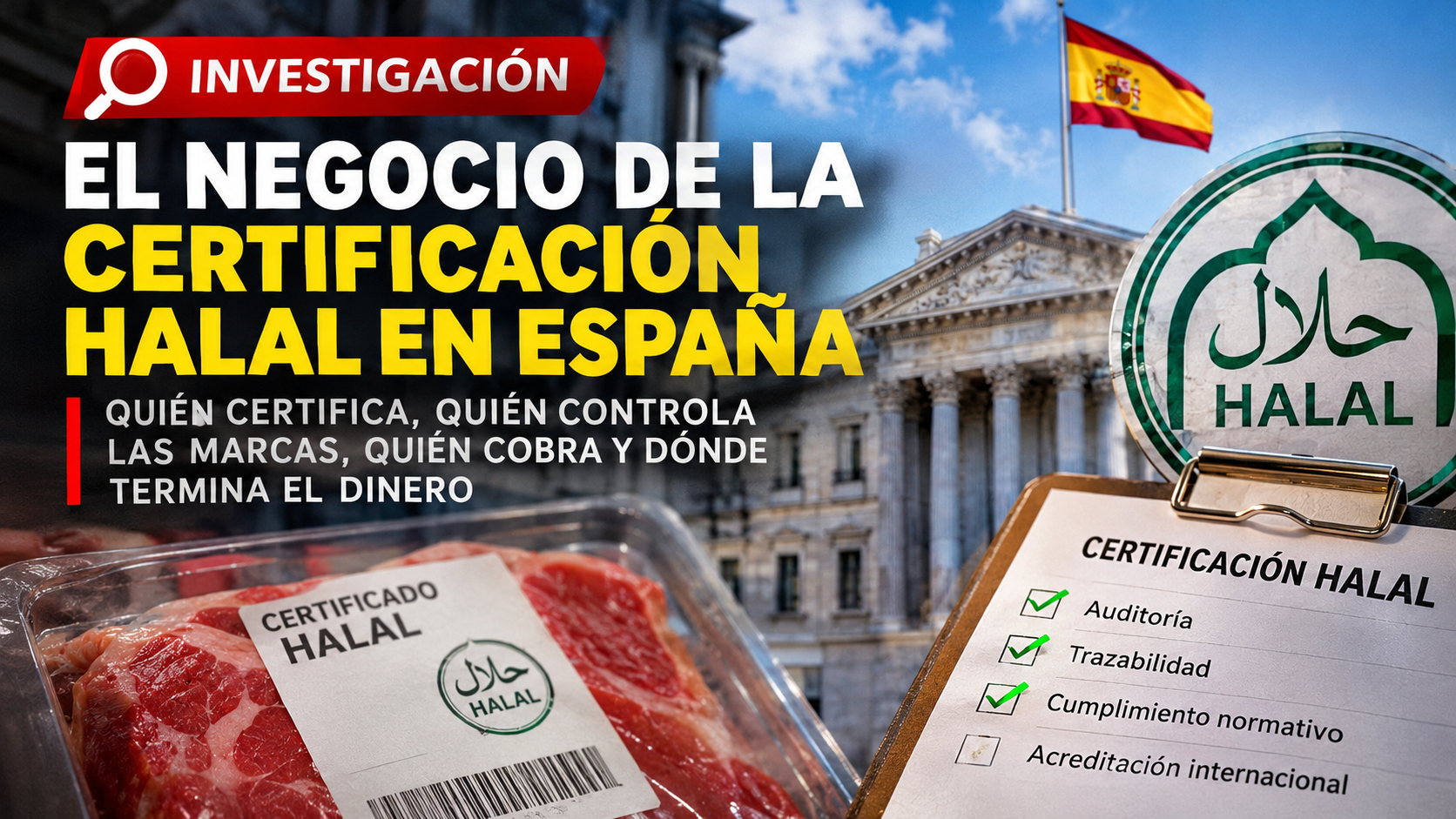
Which companies certify halal products in Spain? Who is behind them? What links exist between certification bodies and religious organisations? How much revenue does this activity generate, and what mechanisms are in place to oversee it?
Halal certification has become an economically significant activity for companies seeking to sell their products in markets with predominantly Muslim populations. Food, meat, cosmetics, ingredients, pharmaceutical products and other goods may require certificates demonstrating compliance with specific religious and technical requirements.
Behind a halal label there may be a private certification company, an organisation linked to a religious institution, or a structure combining ownership of a trademark with the provision of technical services by a commercial company.
Several organisations of this kind operate in Spain. Some have recognition from foreign authorities for exports to specific markets. Others appear in company registers with corporate purposes related to certification, but we have not been able to establish that they hold the same authorisations or are currently carrying out such activities.
This investigation raises several questions of public interest: who controls these entities? Who owns their trademarks? What financial relationships exist between certification bodies and religious organisations? How much revenue do they generate, and where do the profits ultimately go?
The documentation examined makes it possible to identify companies, managers, trademarks and international recognitions. It also establishes certain financial links disclosed by the organisations themselves. However, there is insufficient information to calculate the total turnover of the sector or determine how much money ultimately reaches religious organisations.
The purpose of this investigation is to distinguish documented facts from estimates and from questions that still require answers.
1. The first finding: Spain has no single authorisation for halal certification
One of the first points that needs clarification is that Spain does not have a single state licence that grants a company the status of a halal certifier valid for every market.
Three concepts that are often confused must be distinguished.
1. Company registration. A company may be incorporated and registered with the Commercial Registry with a corporate purpose that includes halal auditing, inspection or certification. This establishes its legal existence and makes it possible to identify its name, tax identification number, directors and other corporate details. It does not, by itself, demonstrate that the company has accredited technical competence.
2. Technical accreditation. This is an assessment of a certification body’s competence, independence and impartiality. One of the main reference standards is UNE-EN ISO/IEC 17065, which applies to bodies certifying products, processes and services. Accreditation has a defined scope: it does not mean that the organisation can certify every product or activity.
3. International recognition. This refers to the acceptance of certificates by the authorities or control systems of destination countries. A certification body may be recognised for exports to the United Arab Emirates without being recognised in Indonesia, Malaysia or Saudi Arabia.
This distinction is essential for exporting companies.
The Catalan agency Prodeca explains that a reliable halal certificate must come from an accredited body and be recognised by the relevant halal authority in the destination market. It also points out that international accreditations may have different geographical scopes.
The Spanish National Accreditation Body (ENAC), for its part, published a specific accreditation scheme for the United Arab Emirates market. This scheme requires compliance with ISO/IEC 17065 and the halal requirements of GSO 2055-2.
Under that scheme, ENAC evaluates technical requirements, while the GCC Accreditation Center (GAC-GCC) assesses religious requirements.
This shows that halal certification is not simply a matter of checking ingredients or placing a logo on packaging. It may also require audit procedures, traceability, assessment of facilities, knowledge of religious standards and recognition by foreign authorities.
The first conclusion is clear: international accreditations and recognitions are important commercial assets. A certification body may have clients in Spain but still be unable to issue certificates accepted by every country to which those clients wish to export.
2. Which Spanish entities have international recognition?
To establish the actual position of certification bodies, it is preferable to consult the registers of foreign authorities that accept their certificates rather than rely solely on company advertising.
United Arab Emirates: three registered Spanish bodies
The United Arab Emirates Ministry of Industry and Advanced Technology (MoIAT) maintains an official register of recognised halal certification bodies.
In the consultation carried out on 5 November 2026, three Spanish bodies appeared with active status:
| Registered body | Issue date | Published expiry date | Status |
|---|---|---|---|
| Estándar Global de Certificación Halal, S.L. (Instituto Halal) | 03/05/2021 | 02/05/2027 | Active |
| Halal Consulting S.L. | 01/04/2018 | 31/03/2027 | Active |
| Halal Food & Quality S.L. | 05/08/2025 | 04/08/2027 | Active |
These entries establish their registration and recognition by the UAE for the scopes authorised to them. They do not constitute universal authorisation to certify all products in every country.
Indonesia: five Spanish entities in ICEX documentation from 2024
The ICEX sector report on the Indonesian halal market, published in 2024, lists five Spanish certification bodies recognised by the Indonesian authority BPJPH:
| Entity listed by ICEX | Location indicated |
|---|---|
| Instituto Halal | Córdoba |
| Halal Quality Control Europe (Spain) | Madrid |
| Halal Consulting S.L. | Málaga |
| Halal Food & Quality | Valencia |
| HFCE Spain | Madrid |
It is important to note that this is a documentary reference from 2024. It should not automatically be treated as confirmation that all five entities maintain exactly the same recognition and scope in November 2026.
The ICEX report itself explains that the Indonesian system changed and that foreign agencies had to undergo the recognition procedures established by BPJPH.
Turkey: recognition of Halal Safety Certification
Turkey’s Halal Accreditation Agency (HAK) published the recognition of Halal Safety Certification S.L. in August 2026.
The register lists:
- Body: Halal Safety Certification S.L.
- Country: Spain.
- Accreditation number: 2026-087.
- Issue date: 03/08/2026.
- Expiry date: 03/08/2031.
- Status: active.
This recognition is another example of how a Spanish certification body can gain access to a specific market through acceptance by a foreign authority.
A preliminary conclusion
Not all entities offering halal services have the same international standing.
Some appear in the UAE register, others are listed in export documentation for Indonesia, and others have obtained recognition from the Turkish authority.
They should therefore not all be presented as having the same accreditations, activities or access to markets.
3. Company map: who is behind them and where are they registered?
The documentary review identifies several Spanish companies connected with halal certification, trademark management or the intermediation of certification services.
They are not all accredited certification bodies. Some have documented international activity, others appear in the Commercial Registry with corporate purposes related to certification, and others act as intermediaries.
The following inventory distinguishes these situations.
3.1. Estándar Global de Certificación Halal S.L. — Instituto Halal
Legal name: Estándar Global de Certificación Halal S.L.
Trade name: Instituto Halal.
Tax identification number: B14865737.
Published address: Calle Claudio Marcelo 17, Córdoba.
Identified director: Clement Randrianantoandro.
Instituto Halal has a different origin from a company established directly by private investors.
According to the organisation itself, Junta Islámica launched Instituto Halal in 1998 as a certification department. In 2003, the Halal Guarantee Trademark of Junta Islámica was registered and, in 2009, Estándar Global de Certificación Halal S.L. was incorporated as a separate commercial company.
Its institutional website states that by 2024 it had certified more than 550 companies worldwide. This is a figure published by the organisation itself, not a turnover figure or an independent audit of the number of certificates issued.
The relationship with Junta Islámica is one of the most relevant findings of this investigation and is examined in the section on trademarks.
A second company: Instituto Halal S.L.
The company documentation examined identifies another company:
Legal name: Instituto Halal S.L.
Tax identification number: B22454888.
Incorporation: May 2025.
Published address: Calle Claudio Marcelo 17, Córdoba.
Sole director: Clement Randrianantoandro.
The company initially appears under the name Garantía Internacional Halal S.L. and subsequently under the name Instituto Halal S.L. Its corporate purpose includes management, coordination and administrative activities related to the development of Article 14 of the 1992 Cooperation Agreement.
The legal notice on institutohalal.com identifies Instituto Halal S.L. as the owner of the website.
It is therefore necessary to distinguish three elements:
- Junta Islámica, the religious organisation linked to the project’s origins.
- Estándar Global de Certificación Halal S.L., the company carrying out certification activities.
- Instituto Halal S.L., the company incorporated in 2025 that appears as the website owner and carries out management and coordination activities.
We have not been able to reconstruct the full corporate and financial relationships between the two commercial companies. This would require examining their accounts, contracts and possible service agreements.
International status: Estándar Global de Certificación Halal S.L. appears as active in the UAE register until 2 May 2027.
3.2. Halal Consulting S.L.
Legal name: Halal Consulting S.L.
Tax identification number: B14818405.
Published registered address: Calle Antonio Márquez Muñoz 30, Torremolinos, Málaga.
Incorporation: 2007.
The company information examined identifies Ahmed Elayan Alhamamra as sole shareholder since 2010 and sole director until April 2025.
The Official Gazette of the Commercial Registry (BORME) published the termination of Ahmed’s role as sole director in May 2025. Yasmin K. H. Alhamamra is also listed as an authorised representative since December 2020.
Ownership and management must be distinguished: ceasing to be a director does not, by itself, prove that Ahmed ceased to be the owner. The business information consulted still lists him as sole shareholder, but an updated Commercial Registry certificate would be needed to confirm the situation as of November 2026.
Its activities include halal certification and services related to food quality and supervision.
International status: it appears active in the UAE register until 31 March 2027. It is also listed in ICEX’s 2024 list of Spanish bodies recognised for Indonesia.
Relationship with religious organisations: we have not found sufficient documentation to demonstrate that this company’s profits are transferred to a religious organisation.
3.3. Halal Food & Quality S.L. — HFQ
Legal name: Halal Food & Quality S.L.
Tax identification number: B98788037.
Published registered address: Paterna, Valencia.
Incorporation: 2016.
Initial share capital: €3,000.
The commercial information consulted identifies Ratbi Bali Said as the company’s sole shareholder and sole director.
HFQ appears in Spanish export documentation as a halal certification body with international recognition. The company itself publishes documentation concerning its guarantee trademark, registered under number M3045430, and its accreditations and international recognitions.
Its technical documentation identifies it as a halal certification body and owner of the Halal Food & Quality guarantee trademark.
International status: it appears active in the UAE register from 5 August 2025 until 4 August 2027. It also appears in ICEX’s 2024 fact sheet on Indonesia.
A piece of information that helps establish its relationship with the public sector is the contract awarded by the Port Authority of Huelva in October 2023.
The contract was for follow-up audits and renewal of halal certification during the 2024-2027 period:
| Contract detail | Information |
|---|---|
| Awarded company | Halal Food & Quality S.L. |
| Amount | €8,000 |
| Award date | 25 October 2023 |
| Offers received | 1 |
| Procedure | Simplified open procedure |
The fact that only one offer was received merits attention, but does not by itself demonstrate a lack of competition or manipulation of the procurement process.
3.4. Halal Safety Certification S.L. — formerly Safety Horizon ECI S.L.
Current legal name: Halal Safety Certification S.L.
Tax identification number: B73953549.
Published address: Calle Mayor 55, Murcia.
Incorporation: February 2017.
Registered share capital in the documentation consulted: €30,000.
The company previously operated as Safety Horizon ECI S.L. and changed its name to Halal Safety Certification S.L. in November 2025.
The Official Gazette of the Commercial Registry records changes to its management structure. These include:
- Anas Abdelrahem Haman Khalifa left the chairmanship and his board positions in November 2025.
- Vicente de Pablos Vicente was appointed chairman.
- El Jaouad El Kaaoui El Band is listed as an authorised representative.
The company documentation consulted also identifies José Francisco Fernández Serna, Ricardo Fisas Verges, Braulio Peramo Moya and José María Pérez Capilla as members of its governing body. An updated registry extract would be advisable before publishing a complete list of current responsibilities.
In August 2026, Turkey’s Halal Accreditation Agency (HAK) published its recognition under number 2026-087, valid until August 2031.
We have not located a reliable turnover figure or documentation establishing a financial relationship between this company and a religious organisation.
3.5. HQC Europe S.L. — formerly Halal Quality Control Europe S.L.
Current legal name: HQC Europe S.L.
Tax identification number: B70671730.
Published address: Paseo de la Castellana 194, Madrid.
Incorporation: February 2024.
Initial share capital: €3,000.
The company was initially incorporated as Halal Quality Control Europe S.L. and subsequently changed its name to HQC Europe S.L.
In January 2026, the Official Gazette of the Commercial Registry published a change in the identity of its sole shareholder: Tarik Groupe S.L. became the sole shareholder.
This detail is important. It would not be correct to present Tarik Azouau Tajja as the current direct owner without knowing the shareholding structure of the holding company.
In the company documentation consulted, Tarik Azouau Tajja appears as director.
Internationally, ICEX included Halal Quality Control Europe (Spain) in its 2024 list of Spanish bodies recognised for Indonesia.
There is also a reference to HQC Europe Spain in Saudi-system documentation for certain product categories. We have not been able to establish with sufficient certainty that this reference amounts to a general current recognition for all its services.
The sole shareholder listed in the Official Gazette is Tarik Groupe S.L. Therefore, identifying who ultimately controls the company would also require examining the structure of that company.
3.6. HFCE Halal Certification España S.L.
Legal name: HFCE Halal Certification España S.L.
Published address: Calle Ulises 16, Madrid.
Incorporation: August 2024.
Initial share capital: €3,000.
Registered sole shareholder and director: Thomas Louis Rodolphe Bietlot.
The Official Gazette of the Commercial Registry expressly states that its corporate purpose includes providing halal certification services for food and non-food products.
ICEX included HCB HFCE Spain in its 2024 Indonesia fact sheet.
However, there is a question that needs clarification: the international recognition of Halal Food Council of Europe ASBL, an organisation domiciled in Belgium, cannot automatically be attributed to the Spanish company.
It is necessary to establish which legal entity signs certification contracts, issues certificates and accepts liability towards clients.
The relationship between HFCE Halal Certification España S.L. and the European structure should be checked through documents before attributing to the Spanish company accreditations that may belong to another entity.
3.7. Halal Global Markets Products Agency S.L.
Tax identification number: B06677264.
Location: Olivenza, Badajoz.
Identified sole director: Aiesh Khatib Ahmad.
Start of operations: March 2015.
Its corporate purpose expressly includes the issuance of halal certifications and the verification of meat products intended for the Arab world.
It appears in historical sector documentation.
However, we have not located a current international recognition that would place it on the same level as the bodies that currently appear in the United Arab Emirates register.
Nor do we have reliable turnover data or sufficient confirmation of its actual activity as of the date of this investigation.
The inclusion of certification activities in a company’s corporate purpose does not, by itself, demonstrate that the company has technical accreditation or international recognition.
3.8. Halal Audit & Quality Alliance S.L.
This is a recently incorporated company.
The Official Gazette of the Commercial Registry published its registration in December 2025, with the following details:
- Start of operations: 31 October 2025.
- Address: Calle de la Medalla 15, Beniel, Murcia.
- Share capital: €3,000.
- Sole shareholder: Nor Eddine Belmeddah Abid.
- Sole director: Nor Eddine Belmeddah Abid.
Its corporate purpose includes certification, auditing, inspection and verification of compliance with halal standards in food, cosmetics, pharmaceuticals, supplements and other products.
We have not found sufficient evidence that it holds international accreditation or recognition from the main foreign authorities consulted.
It is important to remember that a company may include certification activities in its articles of association without having demonstrated the technical competence required to operate under a recognised accreditation system.
3.9. Halal Correct Spain S.L.
Published address: Alicante.
Start of operations: January 2025.
Sole shareholder: Lisa Ramo Beheer BV, a Dutch company.
Sole director: Taoufik Maatoug.
The corporate purpose published in the Official Gazette of the Commercial Registry includes the import and export of food and, in particular, halal products. It also includes acting as an intermediary between clients and Muslim authorities in destination countries to obtain the corresponding certificates.
The group’s website presents Taoufik Maatoug and A. Ali-Salah as founders and describes inspection and certification activities.
However, we have not been able to establish that the Spanish company is, in itself, an independently accredited certification body.
It is therefore important to distinguish between acting as an intermediary to obtain certificates and issuing certificates through an accredited organisation.
3.10. Halal Certification Services S.L.: a company whose tax identification number was revoked
Tax identification number: B88177258.
Incorporation: 2018.
Published registered address: Madrid.
The company appeared to be linked to Halal Certification Services GmbH, a German company, and to Ali Achcar as director.
There is a relevant administrative fact: the Spanish Tax Agency published the revocation of its tax identification number by decision dated 30 September 2024.
The revocation appears in the Official State Gazette in the resolution concerning revoked tax identification numbers.
This fact must be interpreted precisely. Revocation of a tax identification number has administrative and tax consequences, but it does not allow us to attribute criminal conduct to the company or establish, by itself, that the company has been dissolved.
For this reason, it is not included among the bodies with active international recognition that we have been able to verify.
4. Halal trademarks: who owns them and who is allowed to use them?
A fundamental issue is the distinction between the company that carries out certification and the entity that owns the guarantee trademark.
Not all halal certificates use the same seal or operate under the same ownership structure.
The documentation examined makes it possible to identify three particularly relevant cases.
A. The Junta Islámica Halal Guarantee Trademark
Trademark owner: Junta Islámica.
Authorised certification body: Estándar Global de Certificación Halal S.L.
Historical registration: 2003.
This is one of the most important institutional relationships identified during the investigation.
The manual for the use of Junta Islámica’s Halal Guarantee Trademark, published by Estándar Global de Certificación Halal, expressly states that the trademark belongs to Junta Islámica and that Junta Islámica has granted its use to Estándar Global de Certificación Halal S.L.
The guide also states that Instituto Halal grants the trademark to the certification body, which then makes it available to clients whose production systems or services have successfully completed the certification process.
The technical documentation covers, among other matters:
- Authorisation to use the mark.
- Identification of the certified company.
- Assignment of a licence number.
- Conditions for using the mark on products and in advertising.
- Withdrawal, suspension or expiry of the right to use the mark.
There is therefore a documented licensing or authorisation relationship between a religious organisation that owns the trademark and a commercial company that carries out the certification activity.
The financial finding: a funding purpose declared by the organisation itself
The Instituto Halal website contains a particularly relevant statement.
It explains that Junta Islámica launched Instituto Halal in 1998 with two objectives:
- To guarantee the right of access to halal products and services.
- To establish an independent source of funding to support Junta Islámica’s cultural, religious and social projects, without relying on public grants or governments.
This statement comes from the organisation itself, not from an external allegation.
It is a significant finding because it shows that halal certification was also conceived as a way to generate resources for projects run by a religious organisation.
However, it is necessary to distinguish what we know from what we cannot yet demonstrate.
Documented:
- Junta Islámica launched Instituto Halal in 1998.
- The Junta Islámica Halal Guarantee Trademark was registered in 2003, according to the chronology published by the Institute.
- Junta Islámica granted Estándar Global de Certificación Halal S.L. the right to use the trademark.
- The organisation itself states that one of the Institute’s original aims was to generate independent funding for its cultural, religious and social projects.
Not quantified:
- How much money Junta Islámica has actually received.
- What percentage of certification revenue goes to the religious organisation.
- Whether there is a fixed fee, variable fee or payment per certificate.
- What amounts have been transferred in each financial year.
- What proportion of the income is allocated to religious, cultural or social projects.
- What profits the commercial company makes after paying for staff, audits, travel and other expenses.
The declared purpose is documented. The amount of current transfers is not.
To establish it, it would be necessary to examine both organisations’ accounts, licensing agreements and the corresponding invoices or transfers.
B. Halal Spain: the trademark of the Islamic Commission of Spain
Owner: Islamic Commission of Spain.
Trademark: Halal Spain / حلال.
Registration number indicated by the CIE: M3.676.011.
The Islamic Commission of Spain itself explains that it obtained registration of the Halal Spain trademark during 2017 and 2018, in application of Article 14 of Law 26/1992.
The CIE states that it is not an auditing or product-certification company. Its declared role is to own the trademark and establish the conditions for its use and supervision.
This is important because trademark ownership and the provision of certification services are different activities.
The institutional question that arises is:
How is the relationship regulated between the CIE, which holds an institutional liaison position with the State, and the private companies that carry out halal certification?
Registration of the trademark does not, by itself, demonstrate that the CIE owns all certification companies or automatically receives income from every halal certificate issued in Spain.
To understand the economic dimension of the system, it would be necessary to obtain:
- The list of companies authorised to use Halal Spain.
- The trademark’s regulations of use.
- The requirements certification bodies must meet.
- The control procedures.
- Any fees, royalties or licence payments.
- The identity of the entity collecting those amounts.
- The destination of the resulting income.
We have not located a complete public tariff list or an easily verifiable public register of all authorised users of the trademark.
C. Halal Food & Quality trademark
Owner declared in the company’s documentation: Halal Food & Quality S.L.
Trademark number: M3045430.
HFQ publishes technical documentation identifying it as the owner of its own guarantee trademark, registered with the Spanish Patent and Trademark Office.
Its documentation also describes its status as a certification body and the international recognitions it declares to hold.
This trademark should not be confused with the marks linked to Junta Islámica or the Islamic Commission of Spain.
Nor have we found sufficient evidence that HFQ’s profits are transferred to a religious federation or used to finance worship activities.
5. How much money does the halal certification business generate?
This is the most difficult question to answer accurately.
Companies’ annual accounts may show total revenue, but they do not usually separate income from halal certification, audits, inspections, training, consultancy, trademark licences or other services.
A company may have several business lines and generate revenue from all of them.
We must therefore distinguish between:
- Total company turnover.
- Revenue specifically generated by halal certification.
- Revenue generated through use of a guarantee trademark.
- Royalties or licence fees paid to a trademark owner.
- Net profit after expenses.
- Money transferred to a religious organisation.
These are not equivalent measurements.
Available turnover estimates
Some private business-information databases publish turnover estimates for certain companies in this sector. However, these figures do not always come from audited or filed annual accounts, and they do not necessarily separate halal revenue from other activities.
For this reason, it would not be responsible to present estimates for EGCH or Halal Consulting as confirmed halal certification revenue.
We have not found sufficiently robust public information to calculate:
- The total turnover of Spain’s halal certification market.
- Each company’s annual revenue specifically from halal certification.
- The net profit of each certification body.
- Income from trademark licences.
- The amount ultimately transferred to religious organisations.
The figure of more than 550 certified companies worldwide published on the Instituto Halal website is a figure declared by the organisation itself for 2024. It does not make it possible to calculate turnover or profits.
Public-sector money that can be documented
There is a specific public contract that provides information about part of the sector’s commercial activity.
The Port Authority of Huelva awarded Halal Food & Quality S.L. an €8,000 contract to carry out follow-up audits and renew halal certification during the 2024-2027 period.
The procedure received only one bid.
This is a verifiable figure, but it must be interpreted correctly: it represents the value of a specific public contract, not the company’s total turnover or the size of the Spanish halal market.
Where do the profits go?
At present, we can document an explicit religious funding purpose in the case of Instituto Halal and Junta Islámica.
We cannot quantify actual transfers or establish how much the religious organisation currently receives.
For the other companies examined, we have also not found sufficient evidence to claim that their profits finance mosques, religious federations or worship activities.
The absence of documentation does not prove that no payments exist. It means that we do not have the documents necessary to make that claim.
To reconstruct where the money goes, it would be necessary to obtain:
- Annual accounts of certification companies.
- Trademark licensing agreements.
- Royalty or licence invoices.
- Donations and contributions to religious organisations.
- Transfers between companies and associations.
- Financial reports from beneficiary organisations.
6. Is the halal market in Spain being manipulated?
This question requires a definition of what is meant by manipulation.
A market may involve intense competition, business concentration, commercial agreements, demanding entry requirements or trademarks with a prominent position. Not all of these situations are illegal.
Spanish Law 15/2007 on the Defence of Competition prohibits conduct that prevents, restricts or distorts competition. This includes:
- Agreements to fix prices.
- Allocation of markets or customers.
- Coordinated restrictions of competition.
- Certain forms of abuse of a dominant position.
The National Commission on Markets and Competition (CNMC) is the authority responsible for investigating such conduct within its remit.
Issues that warrant investigation
1. Dependence on international recognition
Certification bodies need authorities in importing countries to accept their certificates.
This creates barriers to entry. A company may have technical capacity but still fail to obtain acceptance of its certificate in a particular market.
The UAE list shows that, on the date consulted, only three Spanish bodies appeared as active in its register.
This does not prove that there is a dominant position in Spain, but it does show that international recognition is concentrated among a limited number of entities.
2. Control of guarantee trademarks
In Spain, we find trademarks linked to religious or institutional organisations and others owned by commercial companies.
The case of Junta Islámica and Estándar Global de Certificación Halal is documented through the grant of trademark usage rights.
The case of the Islamic Commission of Spain and Halal Spain raises questions about the conditions under which companies are authorised to use the mark and how its use is supervised.
The existence of these trademarks does not demonstrate anti-competitive conduct. However, it makes it necessary to know the tariffs, access requirements and conditions applied to operators.
3. Limited competition in certain public contracts
HFQ’s contract with the Port Authority of Huelva, worth €8,000, received only one bid.
This is worth monitoring, but it does not demonstrate manipulation, collusion or unlawful restriction of competition.
Assessing the level of competition would require comparing other contracts, bids, prices and procurement procedures.
4. Lack of financial transparency
There is no single public source that allows easy comparison of certification fees, revenue per certificate, trademark royalties or market shares.
This lack of information makes an objective assessment of competition difficult.
Conclusion on possible market manipulation
Not established.
We have not found sufficient documentary evidence of a cartel, coordinated price-fixing or illegal allocation of the Spanish halal market.
There are, however, issues that justify a specific investigation:
- Concentration of certain international recognitions.
- Licensing conditions for guarantee trademarks.
- Competition in public contracts.
- Transparency of commercial relationships.
- Distribution of revenue between certification bodies and trademark owners.
7. What requirements must be met to establish a halal certification body in Spain?
This issue is particularly interesting because it helps explain the barriers to entering the sector.
Three levels must be distinguished.
Level 1. Establishing a company
A person can incorporate a commercial company in Spain, such as a private limited company (Sociedad Limitada), with a corporate purpose that includes auditing, inspection or certification.
Registration with the Commercial Registry allows the company to operate as a business, but does not automatically grant technical competence to certify halal products.
Nor is there a single state licence that turns the company into a universal halal certification body.
Therefore, setting up a company whose corporate purpose includes halal certification does not mean it can issue certificates recognised in every market.
Level 2. Obtaining technical accreditation
One of the main references is the UNE-EN ISO/IEC 17065 standard.
It sets requirements for the competence, impartiality and operation of bodies that certify products, processes and services.
For the UAE scheme, ENAC published additional requirements relating to GSO 2055-2, which establishes general requirements for halal certification bodies.
The specific scheme described by ENAC involves two organisations:
- ENAC evaluates technical requirements.
- GAC-GCC evaluates religious requirements.
The scope of accreditation depends on the product and service categories for which the body demonstrates competence.
The usual requirements for a certification body include:
- Written assessment procedures.
- Competent personnel.
- Qualified auditors.
- Impartiality rules.
- Independence in certification decisions.
- Traceability systems.
- Complaints and appeals procedures.
- Monitoring and periodic audits.
- Document control and activity records.
Accreditation is not a general authorisation to certify every product. Its scope depends on the categories and schemes for which competence has been demonstrated.
Level 3. Obtaining recognition in the destination country
This is one of the main commercial barriers.
Each market may establish its own conditions and recognition procedures.
| Country or market | Relevant authority or system |
|---|---|
| United Arab Emirates | MoIAT and the halal recognition system |
| Saudi Arabia | Authorities and bodies accepted under the Saudi conformity system |
| Indonesia | BPJPH |
| Malaysia | JAKIM |
| Turkey | HAK |
| Gulf countries | GAC-GCC and applicable specific requirements |
Accreditation for a particular market does not guarantee acceptance in others.
An exporting company must check which body is recognised by the destination country and whether the certification body’s scope covers the product it intends to sell.
What if someone wants to create a halal trademark?
In this case, Spanish Law 17/2001 on Trademarks becomes relevant.
Articles 68 and 69 regulate guarantee trademarks.
Article 69 requires an application to be accompanied by regulations governing use of the mark. These must specify, among other things:
- The persons or entities authorised to use the trademark.
- The common characteristics of the products or services being certified.
- Verification methods.
- Controls and monitoring mechanisms.
- Responsibilities arising from improper use.
- Any fee or royalty payable by users, where applicable.
The regulations must go through the legal registration procedure before the Spanish Patent and Trademark Office.
This legislation is particularly important for investigating the economics of halal trademarks.
It is not enough to know who owns a trademark. We also need its regulations of use, licensing agreements, controls and applicable fees.
Finally, food companies must comply with their own health and safety obligations, including registration in the General Sanitary Register of Food Companies and Food Products (RGSEAA) where their activities fall within its scope.
These food safety obligations are independent of halal certification.
8. What we know and what we still cannot establish
The investigation supports several documentary findings, but it also leaves unanswered questions.
| Question | Finding |
|---|---|
| Is there a single Spanish authorisation for halal certification worldwide? | None identified |
| Are Spanish companies recognised by foreign authorities? | Yes |
| Are three Spanish bodies listed as active in the UAE register? | Yes, according to the register consulted |
| Is there a documented relationship between Junta Islámica and Estándar Global de Certificación Halal? | Yes |
| Has Junta Islámica’s guarantee trademark been licensed to EGCH? | Documented in its usage guide |
| Did Instituto Halal state that it intended to generate funding for Junta Islámica’s projects? | Yes |
| Do we know how much money Junta Islámica has received from that activity? | Not quantified |
| Is the CIE the owner of Halal Spain? | Yes, according to its institutional documentation |
| Is the CIE itself a product certification company? | The organisation states that it is not |
| Is the total turnover of Spain’s halal sector known? | Not established |
| Are the individual companies’ revenues from certification known? | Insufficient public information |
| Has it been demonstrated that independent certification companies finance religious organisations? | Not established |
| Has the existence of a cartel or market manipulation been proven? | Not established |
| Are there market entry barriers linked to international recognition? | Yes, documented by accreditation and recognition systems |
| Are all trademark fees and royalties known? | No complete information located |
The distinction between “not established” and “false” is essential. The lack of documents does not allow a claim to be confirmed, but it does not automatically prove the opposite either.
9. Conclusions: a market where commercial, technical and religious interests intersect
Halal certification in Spain has a more complex structure than a simple list of companies placing a logo on products.
The investigation identifies three types of power.
Commercial power: exercised by companies that carry out audits, inspections and certification and charge their business clients for these services.
Technical power: held by organisations that assess whether certification bodies have the competence, impartiality and procedures required within a defined scope.
Institutional and religious power: exercised by organisations that own trademarks, establish religious criteria or hold a recognised position before public administrations and communities.
The Instituto Halal–Junta Islámica case is particularly significant. The organisation itself acknowledges that certification was conceived, among other purposes, as an independent source of funding for its cultural, religious and social projects.
Furthermore, the trademark usage documentation shows that Junta Islámica granted Estándar Global de Certificación Halal the right to use its guarantee trademark.
However, we still do not know how much money this activity has actually generated for Junta Islámica or how much it currently receives.
The Halal Spain–Islamic Commission of Spain case also deserves a specific investigation. The CIE owns a guarantee trademark and states that it establishes the conditions for its use, but it does not present itself as a company that directly certifies products.
On the other hand, certification bodies with international recognition enjoy an important commercial advantage because their certificates can facilitate access to specific export markets.
The investigation has not found sufficient evidence to claim that Spain’s halal market is being manipulated, that customers are being illegally allocated or that there is a coordinated price-fixing system.
It has, however, identified issues requiring greater transparency: trademark usage conditions, licensing agreements, financial relationships between certification bodies and religious organisations, actual sector turnover and the concentration of certain international recognitions.
The central question is not whether the halal business is legitimate or illegitimate. Certification can fulfil a perfectly legitimate commercial and religious function.
The public-interest question is different:
Who controls the trademarks that allow products to be marketed as halal, what requirements must the companies using them meet, how much money is generated through these certifications, and what proportion of that income reaches religious organisations or other structures?
Answering these questions requires access to documents that are not yet sufficiently public: licensing agreements, accounts, fee schedules, financial reports and relationships between companies.
Methodological note
This investigation is a documentary study based on Spanish legislation, Commercial Registry records, publications in the BORME and BOE, international registers, technical documentation from certification bodies, institutional websites and ICEX sector studies.
International registers were consulted with a reference date of 5 November 2026. Where an earlier publication is used, such as ICEX’s 2024 sector fact sheet, it is expressly identified as historical information and not as confirmation of current recognition.
The identification of directors and shareholders is based on the company documentation consulted. Corporate positions may change, and current ownership must be confirmed through an updated Commercial Registry certificate.
We have not had access to bank statements, all private trademark licensing agreements or the internal records of every company mentioned. Nor have we found sufficient public information to calculate the total turnover of Spain’s halal market or the profits received by each religious organisation.
The inclusion of a company in this inventory does not mean that every company has technical accreditation, international recognition or active certification operations. The investigation distinguishes between recognised certification bodies, companies with declared activities, intermediaries and companies whose current status requires further verification.
This investigation does not attribute illegal conduct to any of the entities or individuals mentioned. Its conclusions are limited to what the sources consulted can support.
The companies and organisations mentioned may provide documents or clarifications to complete or correct the information published.
Main sources
Regulations and accreditation
- ENAC: requirements applicable to the ESMA scheme for halal certification bodies.
- Prodeca: the halal sector and certification requirements.
- Law 17/2001 on Trademarks.
- Law 15/2007 on the Defence of Competition.
- CNMC: fighting cartels.
International recognition
- MoIAT: register of halal certification bodies.
- ICEX: The Halal Label in Indonesia, 2024 sector fact sheet.
- Turkey’s Halal Accreditation Agency: accredited bodies.
Instituto Halal, Junta Islámica and trademarks
- Instituto Halal: background and history.
- Instituto Halal: religious vision and origins of the project.
- Instituto Halal: Junta Islámica Halal Guarantee Trademark usage guide.
- Estándar Global de Certificación Halal: general certification conditions.
- Islamic Commission of Spain: Halal certificate and Halal Spain trademark.
- Islamic Commission of Spain: Halal Standardisation Commission.
- Halal Food & Quality: technical documentation on halal product requirements.
Commercial registers and public procurement
- BORME: incorporation of Halal Audit & Quality Alliance S.L., December 2025.
- BORME: incorporation of HFCE Halal Certification España S.L., September 2024.
- BORME: incorporation of Halal Correct Spain S.L., February 2025.
- BORME: change of sole shareholder of HQC Europe S.L., January 2026.
- BORME: changes to the name and management of Halal Safety Certification S.L., November 2025.
- BOE: revocation of the tax identification number of Halal Certification Services S.L., 2024.
- BOE: contract awarded to Halal Food & Quality S.L. by the Port Authority of Huelva, 2023.