
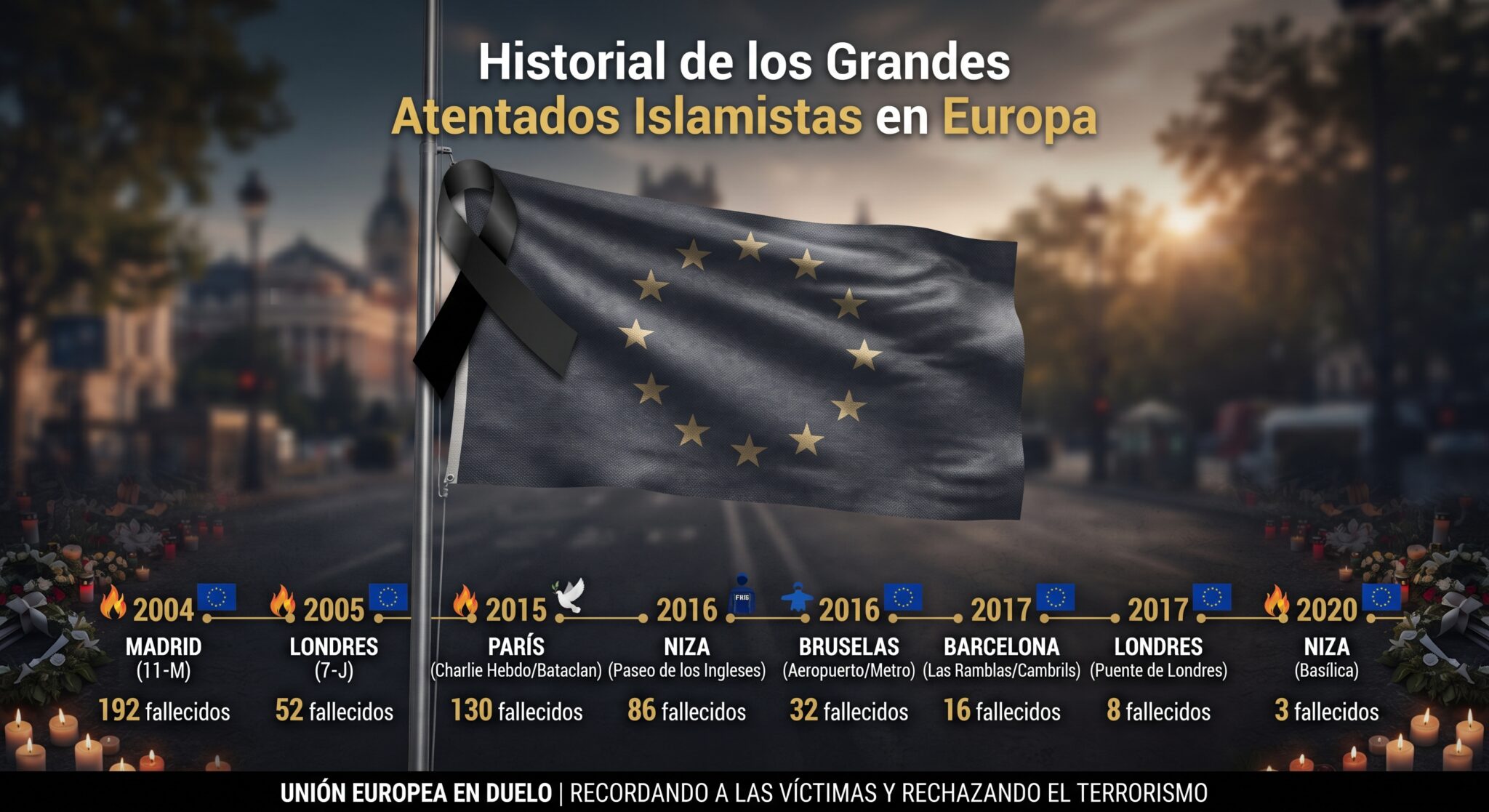
A Century of Attacks, Victims and Change: A Record to Understand a European Problem
Jihadist terrorism is a violent political movement that uses a particular extremist interpretation of Islam to justify murders, attacks and other forms of violence. Millions of European Muslims have no connection to this ideology and have, in fact, also been victims of terrorism. But denying the problem makes no sense either.
Over recent decades, Europe has suffered attacks carried out by organisations such as Al-Qaeda and the Islamic State, by cells linked to them and, increasingly, by individuals who radicalise independently.
The aim of this article is simple: to put the history in order.
What happened, when it happened, where it happened, how many people died, how many were injured and how the threat evolved. This is not a list intended to fuel fear. It is a record that allows us to discuss a real problem using data.
Before we begin: What do we mean by “Islamist terrorism”?
This is where the first difficulty arises.
During the 20th century, numerous terrorist groups of Palestinian, Lebanese, Iranian, Algerian or Middle Eastern origin operated in Europe. But not all of them were Islamist.
Some were nationalist, Marxist, revolutionary or separatist. The fact that a terrorist was Muslim does not automatically make an attack “Islamist”.
For this reason, this record will primarily use the category of jihadist terrorism when there is sufficiently documented attribution to a jihadist organisation or ideology.
Early precedents
The 1970s and 1980s
Terrorism in Europe during these decades was dominated by other ideologies. Europe experienced attacks by groups such as ETA, the IRA, the Red Brigades, the Red Army Faction and various Palestinian organisations.
Some Middle Eastern groups had religious elements, but many were fundamentally nationalist or revolutionary. It is therefore incorrect to present every attack carried out by Arab organisations or Muslim individuals during these decades as “Islamist terrorism”.
The transformation would come particularly with two events: the Iranian Revolution of 1979 and, above all, the war in Afghanistan during the 1980s. The Afghan war helped create international networks of Islamist fighters that would later become important in the development of Al-Qaeda.
1994–1996: Jihadist terrorism emerges clearly in France
One of the first major episodes of this new phase took place in France during the Algerian Civil War. The Armed Islamic Group (GIA) brought some of its violence onto French territory.
1994 — Air France Flight 8969 hijacking
Date: December 1994 Location: Algeria/France Organisation: GIA Target: Passenger aircraft Outcome: All four hijackers were killed during the intervention; several passengers were injured.
The episode demonstrated that the Algerian conflict could spill over into Europe.
1995 — GIA attacks in France
During 1995, France suffered a campaign of attacks, particularly in Paris and its transport network.
The best-known attack was the explosion at Saint-Michel station on 25 July 1995.
Deaths: 8 Injuries: More than 100.
Other attacks and attempted attacks followed.
That campaign was a warning of what was to come: international terrorism, transnational networks and the use of Europe as a stage for an ideological war whose roots lay outside the continent.
2001: The world changes
The attacks of 11 September 2001 did not take place in Europe, but they completely changed Europe’s perception of terrorism.
The attacks in New York and Washington demonstrated that Al-Qaeda could organise international operations on a scale that had previously seemed unimaginable.
From then on, European intelligence services paid much greater attention to jihadist networks. Europe progressively became one of Al-Qaeda’s main targets.
2004 — Madrid
11 March 2004
Location: Madrid, Spain Target: Commuter trains Method: Explosives Deaths: 193 Injuries: Around 2,000
This was the deadliest jihadist attack suffered by Spain and one of the most serious in European history. Several bombs exploded on commuter trains during rush hour.
The attack was attributed to a cell ideologically linked to Al-Qaeda. Madrid demonstrated that Europe was not merely a place for radicalisation or transit; it could also become the scene of mass-casualty attacks.
2005 — London
7 July 2005
Location: London, United Kingdom Targets: Public transport Method: Explosives Deaths: 52 victims, in addition to the four attackers Injuries: More than 700
Four suicide bombers simultaneously attacked London’s transport system. Three explosions occurred on the Underground and another on a bus.
It was one of the first major jihadist attacks in Western Europe carried out by individuals living in the country itself. This introduced a new concern: radicalisation within Europe.
2007 — London and Glasgow
Several attempted attacks took place in the United Kingdom in 2007.
Two vehicles loaded with explosives were used in London, followed by an attack on Glasgow Airport.
These incidents did not cause a massacre comparable to Madrid or London in 2005, but they demonstrated that jihadist networks remained active.
2012 — Toulouse
March 2012
Location: Toulouse and Montauban, France Perpetrator: Mohamed Merah Ideology: Jihadism Deaths: 7 Injuries: Several
Merah murdered military personnel and subsequently attacked a Jewish school.
The case was particularly important because it demonstrated a pattern that would later become more common: an individual who becomes radicalised and acts almost entirely alone.
2014 — Brussels
Jewish Museum of Brussels
Date: 24 May 2014 Location: Brussels, Belgium Deaths: 4 Injuries: Several
The attacker had been in contact with jihadist networks and had travelled to Syria.
The attack foreshadowed a new phase: European fighters travelling to Syria and Iraq, receiving training or coming into contact with organisations, and subsequently returning to Europe.
2015: The year that changed Europe
2015 was probably the most significant year in the recent history of European jihadist terrorism. Europe suffered a succession of attacks.
7 January — Charlie Hebdo
Location: Paris Deaths: 12 Injuries: Approximately 11
The Kouachi brothers attacked the offices of the satirical magazine Charlie Hebdo. They claimed to be acting on behalf of Al-Qaeda in the Arabian Peninsula.
8–9 January — Paris
Amedy Coulibaly murdered a police officer and subsequently attacked a kosher supermarket.
Deaths: 5, including the attacker. Fatalities among victims: 4.
The episode was ideologically connected to the earlier attacks.
13 November — Paris
This was one of the most serious attacks in recent European history.
Location: Paris Organisation: Islamic State Targets: The Bataclan concert hall, restaurants, bars and the area around the Stade de France Deaths: 130 victims Injuries: Hundreds
It was a coordinated operation involving several attackers. The Islamic State sought to turn Paris into a symbol of its war against the West.
The attack marked the beginning of the deadliest phase of Islamic State terrorism in Europe.
2016: The Islamic State strikes Europe
22 March — Brussels
Location: Brussels Airport and metro Deaths: 32 victims Injuries: More than 300
The attacks were claimed by the Islamic State.
14 July — Nice
Location: Promenade des Anglais, Nice, France Method: Vehicle Deaths: 86 Injuries: More than 400
A lorry was used to deliberately run over people celebrating France’s national day. The Islamic State subsequently claimed responsibility.
Nice was a turning point because it demonstrated that an ordinary vehicle could become a highly destructive terrorist weapon.
July 2016 — Germany
Germany experienced several episodes of violence linked to jihadism.
Among the most notable were:
-
Würzburg: A knife attack against passengers on a train.
-
Ansbach: A bombing.
-
Berlin: An attack on a Christmas market.
19 December — Berlin
Location: Breitscheidplatz Christmas market Perpetrator: Anis Amri Method: Vehicle Deaths: 12 Injuries: Dozens
Amri used a lorry to run over people at the market. The Islamic State claimed responsibility.
2017: The “lone wolf” attacks
2017 was another particularly difficult year, but a change was becoming apparent. Instead of large international operations, more individuals were acting alone or with limited assistance.
London — Westminster
22 March 2017
Deaths: 5 victims Injuries: Around 50
A vehicle struck pedestrians on Westminster Bridge before a knife attack followed.
Manchester — 22 May
Location: Manchester Arena Deaths: 22 Injuries: Hundreds
Salman Abedi detonated an explosive device at the end of a concert. Many of those killed were children.
London — London Bridge
3 June
Deaths: 8 Injuries: Dozens
The attackers used a vehicle and subsequently bladed weapons.
Barcelona and Cambrils: August 2017
For Spain, this is one of the most important chapters.
17 August — Barcelona
Location: Las Ramblas Method: Vehicle Deaths: 14 victims directly in Barcelona, plus one victim subsequently linked to the perpetrators’ escape Injuries: More than 100
A jihadist cell used a van to run over pedestrians.
18 August — Cambrils
The same cell attempted another attack.
Deaths: 1 victim Injuries: Several people.
The attackers were shot dead by police. In total, the Barcelona and Cambrils attacks caused 16 fatalities.
2018: Fewer massacres, but the problem continues
The scale of attacks declined in 2018, but the threat did not disappear.
Among the most significant attacks were:
Carcassonne and Trèbes — France
23 March 2018
Deaths: 4.
The attacker took hostages in a supermarket.
Paris
12 May 2018
Deaths: 1 victim.
Knife attack.
Liège — Belgium
29 May 2018
Deaths: 3 victims.
Strasbourg — France
11 December 2018
Deaths: 5 Injuries: Approximately a dozen.
The attack took place at Strasbourg’s Christmas market.
Europol recorded thirteen deaths from jihadist attacks in the EU in 2018, although the number of victims and the severity of the attacks had fallen considerably compared with 2015–2017.
2019: Terrorism does not disappear
Utrecht — Netherlands
18 March 2019
A man opened fire on passengers on a tram.
Deaths: 4.
London — November 2019
A former terrorism convict attacked people in the vicinity of London Bridge.
Deaths: 2.
The trend was becoming clear:
Fewer large-scale operations and more individual attacks.
2020: France returns to the centre of events
2020 was particularly difficult for France.
Samuel Paty
16 October 2020 Conflans-Sainte-Honorine
Teacher Samuel Paty was murdered by an attacker who claimed to be acting in response to cartoons of Muhammad shown in an educational context.
Deaths: 1.
The murder caused enormous national shock.
Nice — 29 October
An attacker murdered three people in the Notre-Dame Basilica in Nice.
Deaths: 3.
The attack occurred just weeks after Samuel Paty’s murder.
2021
The intensity of major attacks continued to decline, but individual attacks persisted.
One of the most significant cases was:
Rambouillet — France
23 April 2021
A female police employee was stabbed to death.
Deaths: 1.
The case was treated as terrorism.
2022: Few attacks, but extensive prevention efforts
Here we encounter a reality that is often overlooked. The absence of major attacks does not mean the absence of terrorism.
In 2022, Europol recorded two completed jihadist attacks within the European Union, out of a total of 28 terrorist attacks that were completed, failed or foiled.
There were two fatalities caused by jihadist terrorism. At the same time, numerous investigations and arrests took place. The threat was changing.
2023
In 2023, Europol recorded:
-
14 jihadist attacks.
-
Of these, 5 were completed.
-
They caused 6 deaths and 12 injuries.
Jihadism was once again the deadliest form of terrorism within the European Union that year.
Among the most significant attacks were:
Arras — France
13 October 2023
A teacher was murdered in an attack at a school.
Deaths: 1.
Brussels
16 October 2023
An attacker shot Swedish citizens.
Deaths: 2.
Paris
2 December 2023
An attacker killed one person and injured others near the Eiffel Tower.
2024: The number of attacks rises again
In 2024, Europol recorded 24 jihadist attacks in the European Union.
Of these, 6 were completed and 18 were foiled.
The toll was 5 deaths and 18 injuries.
This is significant. The total number of completed jihadist attacks remained relatively small, but security services were detecting and dismantling a considerable number of plots before they could be carried out.
Solingen — Germany, 2024
One of the most significant attacks of 2024 was the attack in Solingen.
Date: 23 August 2024 Location: Solingen city festival Perpetrator: Islamic State sympathiser Deaths: 3 Injuries: 10
The Islamic State claimed responsibility for the attack. Europol notes that the attacker had been in contact with a person linked to the Islamic State through a messaging service.
2025: The threat continues, but changes shape
The latest available data suggest that European jihadist terrorism is evolving differently from what was seen during the Islamic State’s period of territorial control.
An analysis by START InSight counted 12 jihadist incidents in Europe during 2025, compared with 15 in 2024. The same analysis notes that the dominant pattern is increasingly individual: improvised attacks carried out by people who are not part of large cells.
Significant incidents in 2025 included attacks in:
Munich — February
Vehicle attack during a demonstration.
2 deaths and dozens of injuries.
Villach — Austria, February
Knife attack.
1 death and several injuries.
Mulhouse — France, February
Knife attack.
1 death and several injuries.
However, an important caveat is necessary: the definitive classification of some incidents may change following judicial investigations.
That is why reliable records are updated over time.
The great shift: From Al-Qaeda to the Islamic State
Looking at the entire historical period, we can distinguish several phases.
First phase: International terrorism
The 1990s and early 2000s
Al-Qaeda and its networks were the main protagonists. Attacks generally required planning, cells, international contacts, funding and logistics. Madrid and London are classic examples.
Second phase: The Islamic State
Approximately 2014–2017
The emergence of the Islamic State changed the landscape. Syria and Iraq became centres for training and propaganda.
Thousands of Europeans travelled to the region, and propaganda encouraging attacks in Europe spread from there.
The result was some of the deadliest attacks:
Paris 2015, Brussels 2016, Nice 2016, Berlin 2016, Manchester 2017 and Barcelona 2017.
Third phase: The “lone wolf”
After the Islamic State lost its territorial stronghold, the phenomenon changed. It was no longer necessary to travel to Syria, form a large cell or obtain large quantities of explosives. An individual could become radicalised primarily online and decide to act.
Europol has repeatedly highlighted the importance of individual actors and online propaganda. In 2022, for example, Europol noted that most attacks were committed by individuals acting alone, and more recent analyses indicate that this trend has become established.
Which attacks have been the deadliest?
Here is a simplified list of some of the deadliest jihadist attacks in Western Europe since the beginning of the 21st century:
| Year | Location | Fatalities |
|---|---|---|
| 2004 | Madrid | 193 |
| 2015 | Paris | 130 |
| 2016 | Nice | 86 |
| 2005 | London | 52 |
| 2016 | Brussels | 32 |
| 2017 | Manchester | 22 |
| 2017 | Barcelona/Cambrils | 16 |
| 2016 | Berlin | 12 |
| 2015 | Charlie Hebdo | 12 |
| 2012 | Toulouse | 7 |
| 2018 | Strasbourg | 5 |
| 2019 | Utrecht | 4 |
| 2018 | Trèbes | 4 |
| 2014 | Brussels | 4 |
The attacks in Madrid, Paris, Nice, London, Brussels, Manchester, Barcelona, Berlin and the Charlie Hebdo shooting stand out as particularly deadly reference points in this record.
But there is a second list we rarely see
There is another, far less visible figure: foiled attacks. And this is fundamental.
An attack that never takes place does not appear in death statistics, but behind it may lie months of police investigations.
In 2024, Europol recorded 24 jihadist attacks, but only 6 were completed. The other 18 were foiled.
This means that looking only at images of completed attacks gives us an incomplete picture of the problem.
Has jihadist terrorism increased or decreased in Europe?
The simple answer is that Europe no longer experiences the same level of jihadist terrorism it suffered between 2015 and 2017. But that does not mean the threat has disappeared. The data show a transformation.
Instead of large coordinated operations, we increasingly see isolated individuals, small groups, online radicalisation, improvised attacks, simple weapons, civilian targets and individuals inspired by terrorist organisations without formally belonging to them.
A recent study of jihadist terrorism in Europe makes precisely this point: the trend has shifted from large coordinated operations to individual, less sophisticated attacks.
Why is Europe a target?
Jihadist groups have identified several reasons.
First, they see European societies as ideological enemies.
Second, Europe has large urban concentrations.
Third, European societies offer symbolic targets and enormous media exposure.
Fourth, European citizens themselves can be radicalised within Europe. This is probably one of the most significant changes of recent decades.
What does this historical record teach us?
There are five major conclusions.
1. European jihadist terrorism did not begin with the Islamic State
Its roots go much further back.
2. Al-Qaeda and the Islamic State represented different phases
They are not exactly the same phenomenon.
3. The threat has changed
Europe has moved from confronting large international cells to increasingly confronting radicalised individuals.
4. The number of attacks does not tell the whole story
Failed and foiled attacks must also be counted.
5. Prevention is as important as response
If we wait until an attack takes place before acting, we are already too late.
Europe has won a battle, but not necessarily the war
Following the attacks in Madrid, London, Paris, Brussels, Nice, Berlin, Manchester and Barcelona, Europe developed a substantial capacity for counterterrorism cooperation.
Europol, national intelligence services, police forces, border authorities and prosecutors now share much more information than they did twenty years ago. The figures reflect these efforts.
In 2024, for example, Europol recorded 24 jihadist attacks in the EU, but 18 were foiled.
In 2025, jihadist terrorism remained the leading category of terrorism by number of incidents and related arrests within the EU, although most law-enforcement activity concerned propaganda and support activities rather than completed attacks.
That is good news, but it also carries a warning. Terrorism does not disappear simply because an organisation disappears. It can change its name or methods, moving from a cell to an individual.
It can move from a mosque or training camp to a mobile phone, and it can re-emerge when a new international crisis provides a narrative capable of mobilising people who have already been radicalised.
Europe’s future challenge is not merely to defeat a terrorist organisation. It is to prevent a violent ideology from turning an international crisis or digital propaganda into a murder in a European city. Terrorism changes, and Europe must change with it.
Table of deaths and injuries caused by attacks
| Year | Deaths | Injuries |
|---|---|---|
| 1990 | 0 | 0 |
| 1991 | 0 | 0 |
| 1992 | 0 | 0 |
| 1993 | 0 | 0 |
| 1994 | 3 | 25 |
| 1995 | 8 | 157 |
| 1996 | 0 | 0 |
| 1997 | 0 | 0 |
| 1998 | 0 | 0 |
| 1999 | 0 | 0 |
| 2000 | 0 | 0 |
| 2001 | 0 | 0 |
| 2002 | 0 | 0 |
| 2003 | 55 | 750+ |
| 2004 | 194 | 2,052 |
| 2005 | 52 | 784 |
| 2006 | 0 | 0 |
| 2007 | 0 | 5 |
| 2008 | 0 | 0 |
| 2009 | 0 | 2 |
| 2010 | 0 | 3 |
| 2011 | 2 | 2 |
| 2012 | 7 | 6 |
| 2013 | 1 | 1 |
| 2014 | 4 | 14 |
| 2015 | 150 | ≈350+ |
| 2016 | 198* | ≈500+ |
| 2017 | ≈70 | ≈1,000 |
| 2018 | 13 | 46 |
| 2019 | 10 | ≈100 |
| 2020 | 12 | ≈50 |
| 2021 | 2 | ≈20 |
| 2022 | 3 | ≈20 |
| 2023 | 6 | 12 |
| 2024 | ≈175* | ≈620+ |
| 2025 | ≈10 | ≈80 |
| TOTAL | ≈1,000 | ≈6,500+ |
Note: This record should be understood as a chronology of major jihadist attacks causing casualties in Europe, not as a literal transcription of a single database.
Main sources: Europol, the Global Terrorism Database (START/University of Maryland), the Jihadi Plots in Europe Dataset and specialised academic studies.